
WhatsApp Delivery Rate Dropping? What Actually Fixes It
Why D2C WhatsApp messages stop reaching customers, why your open rate hides it, and the fixes that took delivery from 23% to 44% in a month.
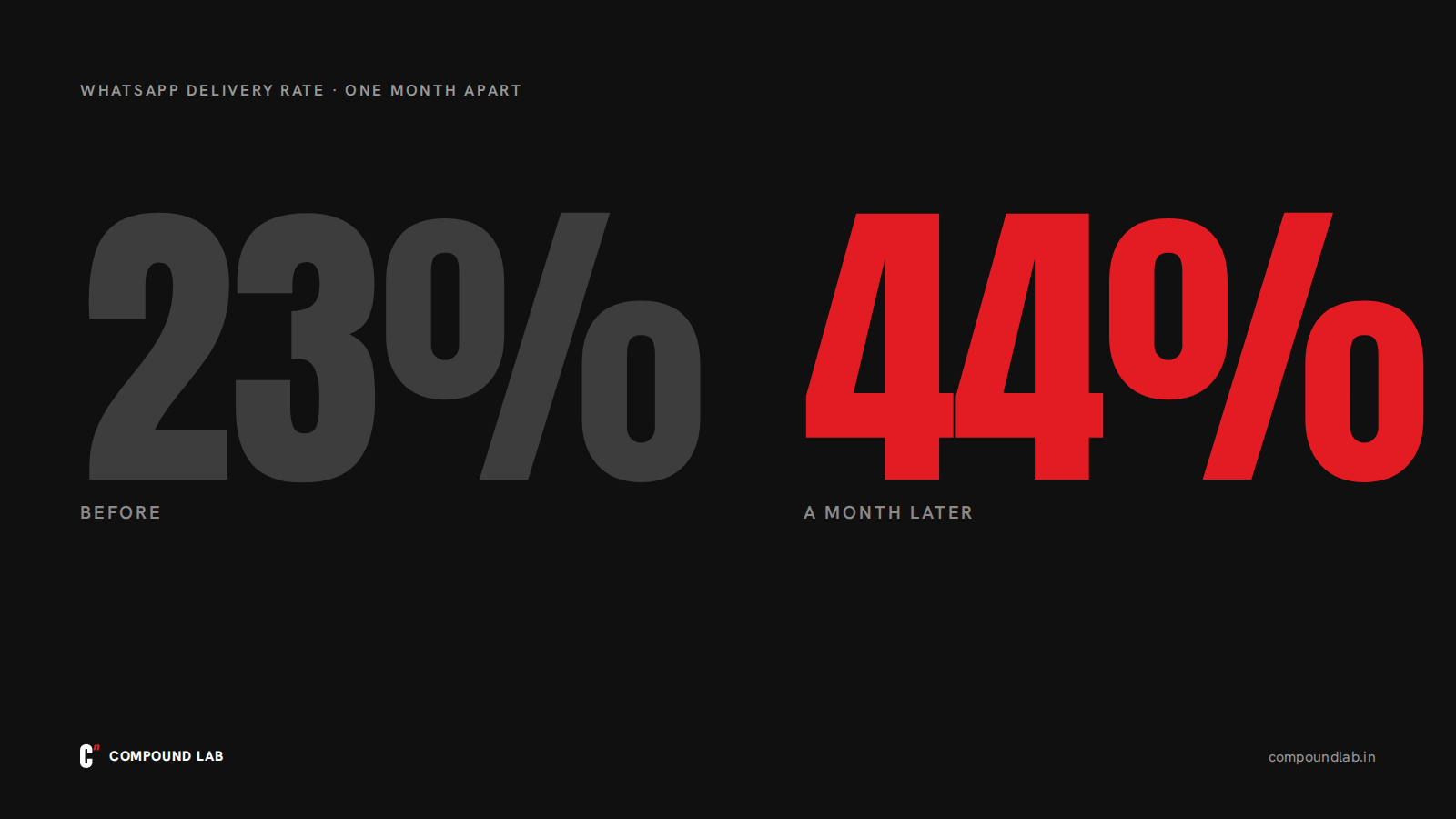
If your WhatsApp delivery rate is sliding, the cause is rarely your copy or your BSP. It is usually the signals Meta reads from how you message: how often you send, whether customers ever reply to your marketing number, and whether messages are triggered by intent or blasted on a schedule. Fix those signals and delivery recovers. Keep reading your open rate and you will never see the problem in the first place.
This is what I found, and fixed, while leading retention at a premium cookware brand with a high average order value and a narrow product range.
The slow slide nobody panicked about
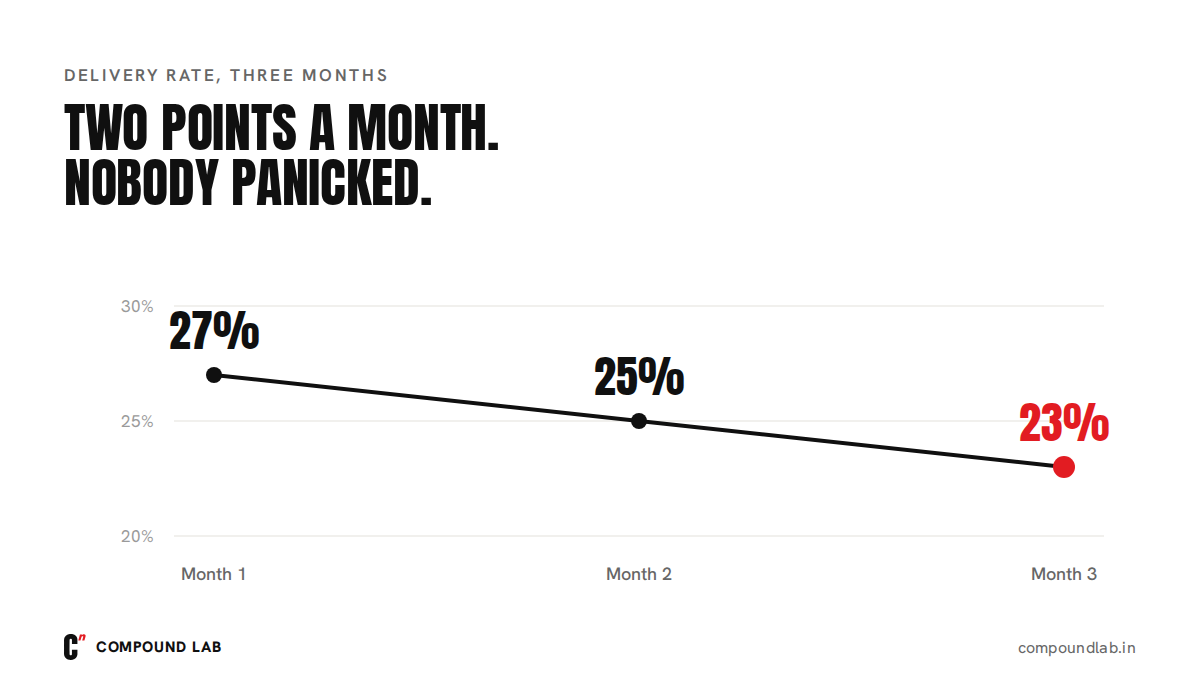
When I joined, WhatsApp delivery had gone from 27% to 25% to 23% over three months. Two points a month doesn't set off alarms. That is exactly why it got missed.
At 23%, 77 out of every 100 customers the brand messaged never received a thing. The team thought it had an engagement problem. In reality, most of its customers had simply stopped hearing from it.
Why your open rate hides undelivered WhatsApp messages
Open rate is calculated on messages delivered, not messages sent. So the dashboard looked fine. Of the messages that arrived, 40 to 45% were opened, which is healthy.
Here is what that looked like for every 1,000 messages sent:
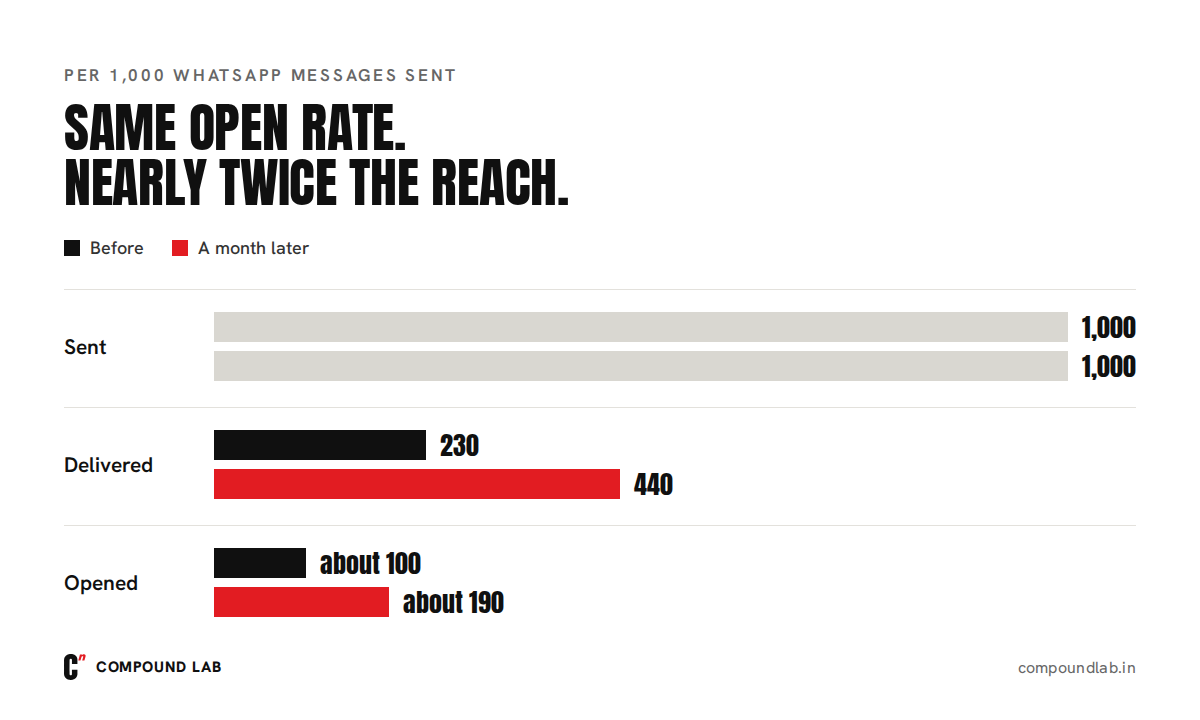
Click-through and conversion rates held steady, so clicks and orders rose about 1.9x, in line with delivery. The copy stayed the same. Nearly twice as many people received it.
The open rate never moved. A team watching open rate would have seen nothing wrong before, and nothing fixed after. Watch your sent-to-delivered rate, meaning messages delivered out of messages sent, every week.
Why WhatsApp marketing messages stop getting delivered: five causes
I downloaded the full reports from the brand's engagement platform and mapped every metric's decline over time. Five patterns stood out.
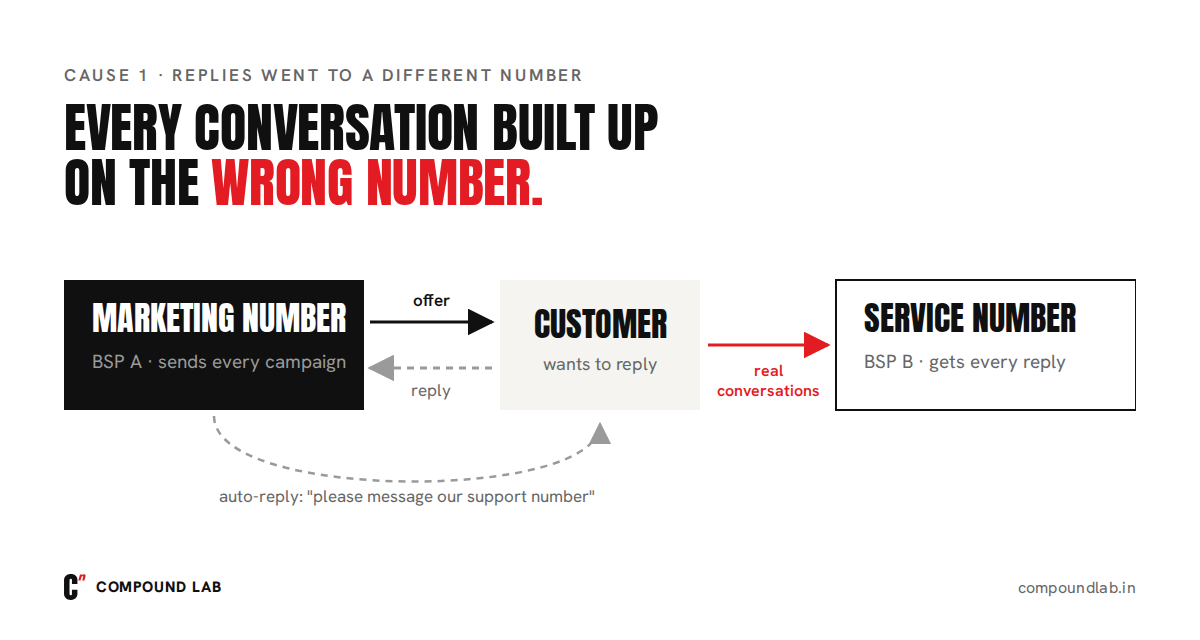
1. Replies went to a different number. Marketing messages went out from one number, on one BSP. Customer service ran on a second number, on a different BSP. When a customer replied to a marketing message, an auto-reply pointed them to the service number. Every real conversation built up on the service number, and the marketing number looked like it only ever talked at people. This setup is common in India, where brands pick one vendor for marketing and another for support.
2. Frequency. Customers were getting three to four marketing messages a week. For a brand with a narrow cross-sell range, most of those messages had nothing new to say.
3. Broadcasts instead of journeys. Segmentation was good, but everything went out as bulk sends at fixed times. Nothing was triggered by what a customer had just done, and nothing was personalised. An abandoned-cart message didn't even name the product.
4. No verified badge. The number had no blue tick, and its business profile was thin. A message from an unverified business is easier to ignore, block or report.
5. No automatic retries. Failed messages stayed failed. Any retry meant rebuilding the segment by hand.
Meta's own documentation backs part of this. Its per-user marketing limit adapts to each person's recent read rate for marketing messages and how crowded their inbox is. And when a customer replies, it opens a 24-hour customer service window, and marketing messages sent inside that window don't count towards the limit. The rest is what I observed: the account that sent less, got replies and triggered messages on intent got its messages delivered.
How to find out why your WhatsApp messages failed
You don't have to guess. Every failed message comes back with an error code, which your platform's delivery report or webhook logs will show. Three codes explain most marketing failures:
- 131049: the message wasn't delivered "to maintain healthy ecosystem engagement". In practice, the customer hit WhatsApp's per-user marketing limit. This is the one behind a slow slide.
- 131050: the customer has chosen to stop receiving marketing messages from your business.
- 131048: too many of your earlier messages were blocked or flagged as spam, so your number is being rate limited.
Meta keeps the full list in its WhatsApp error codes reference. Pull a week of failures, group them by code, and you'll know which of the five causes above you're dealing with.
What we changed
We fixed dependencies first, because some changes needed other teams.
Verification. We applied for the blue tick, formally an Official Business Account, through our BSP, which required press coverage of the brand, and added the full business profile and website catalog to the WhatsApp page.
Two-way conversation on the marketing number. We set up an AI bot with brand communication guidelines, and hard guardrails that handed conversations to a human when needed. Marketing messages carried quick-reply buttons, so customers started conversations on that number. The handoff mattered more than the bot. Customers kept replying because they could reach a person when they needed one.
A frequency cap. Micro-segments, and a hard rule of two WhatsApp messages per customer per week, down from four.
Segments built for receptiveness. Fewer messages only work if each one lands with the right person. A customer who gets a message that fits what they bought and where they are in their journey is far more likely to reply or click. Those replies and clicks are the signals Meta reads when it decides whether your next message is worth delivering. So better segmentation lifted delivery as well as conversion.
The three-day quiet rule. We mapped the events customers triggered and the products they bought, and moved as much as we could from broadcasts into automated journeys. Anyone who received an automated, intent-based message in the last three days was excluded from broadcasts. Customers heard from us when they had just done something, not because it was 10am on a Tuesday.
Service-led messages. We started reaching customers with genuinely useful post-purchase content, like care and seasoning guidance for what they had bought. Customers who had never been reached started clicking. Keep these truly service-led. Meta's template guidelines say utility messages must be non-promotional, and businesses that keep sending marketing as utility face escalating restrictions.
Manual retries. Our setup had no automatic retry, so failed segments were re-sent the next day by hand. That matches Meta's own guidance: wait at least 24 hours before resending after a 131049 failure, because resending sooner brings more errors and muddies your delivery reporting. It worked, but it cost us clean reporting.
The result, and the honest part
Delivery went from 23% to 44% in a month, a 91% lift. Messages reaching customers rose 1.9x, and opens, clicks and orders per 100 messages sent rose with them. That month, CRM brought in ₹21.3 lakh in revenue, most of it through WhatsApp, with email making up the rest.
The honest part: 44% is a blended number. Utility messages deliver far more reliably than marketing messages, so adding them lifted the average along with the fixes above. I can't tell you how much of the gain came from each, because marketing and utility delivery were reported together.
If I started again, that is the first thing I would change. Report marketing and utility delivery separately from day one, or you will never know which fix actually worked.
What founders usually blame, and why it's usually wrong
"Our messages are bad, so people are blocking us." Heavy blocking drops your number's quality rating and Meta flags the account. That is a loud failure. A slow two-points-a-month slide points to weak engagement signals and frequency, not a wave of blocks.
"Our BSP isn't good enough." Switching vendors usually keeps the same number, the same sending habits and the same signal history, so the problem moves with you. We nearly doubled reach without switching.
There is one platform decision that does matter. Before you pay for an expensive engagement platform that routes WhatsApp through a third-party BSP, check whether it offers automatic retries of failed messages. Many WhatsApp-native BSPs do. Unless you are running a very high volume of events, a native BSP with smart retry is usually the better first choice.
How I audit a brand's WhatsApp in 30 minutes
- Trust: blue tick, a complete business profile, website catalog linked.
- Frequency: messages per customer per week, and per month.
- Automations versus broadcasts: which journeys are live, and whether broadcasts exclude people who just got an automated message.
- Template formats: image, video and carousel. Carousels lifted our CTR because customers chose from several products instead of landing on one.
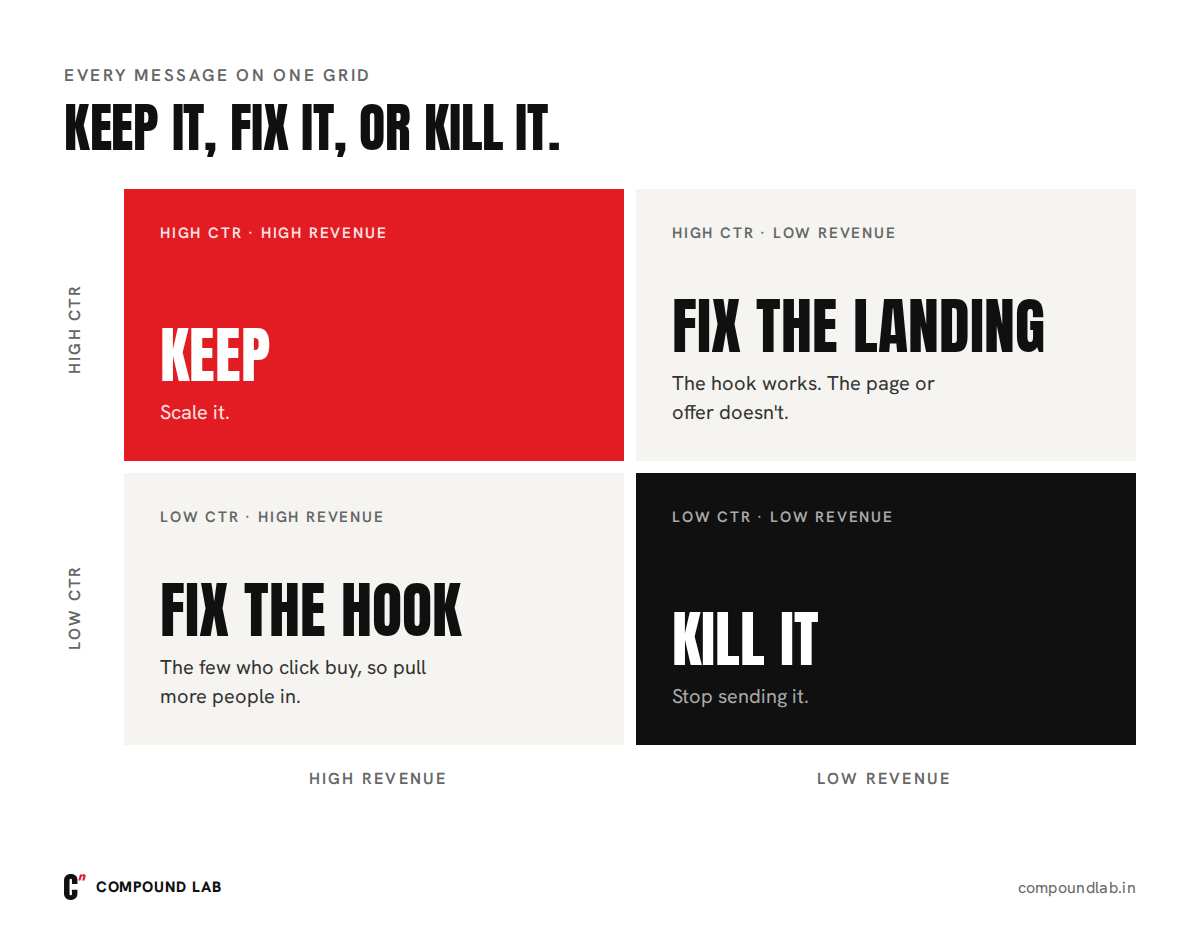
- Every message placed on this grid:
FAQ
What is a good WhatsApp delivery rate for a D2C brand? Track it against your own history before comparing with others. A steady decline matters more than any single number. Split marketing and utility delivery, because they behave very differently.
What does WhatsApp error 131049 mean? The customer has reached WhatsApp's per-user limit for marketing messages, which adapts to how often they read marketing messages. Wait at least 24 hours before resending, and send less to people who rarely read.
Does a blue tick improve WhatsApp delivery? Meta doesn't say it does. It builds trust, and trust makes customers less likely to block or report you, which protects delivery over time.
How many WhatsApp marketing messages should a brand send per week? We capped it at two per customer per week, and excluded anyone who had just received an automated message. The right number depends on how much you genuinely have to say.
Should I switch BSPs if delivery is low? Usually not first. Fix frequency, conversation and targeting, then check whether your platform supports automatic retries.
If your WhatsApp numbers look like this, my audit covers all five checks and the grid, on your own data. Book a retention audit.
The full story, with the before and after, is in the Cumin Co WhatsApp delivery case study. More of this work is in my case studies.