
What Is a Good Repeat Purchase Rate? D2C Benchmarks (2026)
What a good repeat purchase rate looks like for D2C brands, by category. Published benchmarks, why refill and cross-sell brands differ, how to raise it.
Updated October 2026.
A good repeat purchase rate is usually quoted as 20% to 30% of customers buying again within a year. That number only helps if your product behaves like the average. A brand whose product runs out every month and a brand whose product lasts ten years shouldn't chase the same benchmark.
So the useful answer has three parts. Know which kind of repeat your category gets. Measure it over a period that fits how fast customers need you again. And read it next to how many new customers you're bringing in, because that changes the number more than most founders expect.
Repeat purchase rate, also called repeat customer rate, is the share of your customers who have bought from you more than once in a period. The formula is customers with two or more orders ÷ all customers in the period × 100. Some teams track repeat order rate instead, the share of orders that come from returning customers.
I've run repeat purchase for both kinds of brand. At HealthifyStore, customers reordered protein and supplements when they ran out. At Cumin Co, a cast iron pan lasts close to ten years, so repeat had to come from the next product. To work out your own rate, use the repeat purchase rate calculator.
What is a good repeat purchase rate?
Published benchmarks agree on the broad range and disagree on the details. The table below shows repeat purchase rate benchmarks by industry from two sources, as of October 2026.
| Category | Measured over | Benchmark | Source |
|---|---|---|---|
| Ecommerce overall | Not stated | About 20% to 30% | Klaviyo |
| Fashion | 12 months | 20% to 30% | Count, industry estimate |
| Beauty | 12 months | 25% to 35% | Count, industry estimate |
| Electronics | 12 months | 15% to 25% | Count, industry estimate |
| Subscription boxes | 6 months | 40% to 60% | Count, industry estimate |
Sources: Klaviyo's glossary page on what a good repeat purchase rate is and Count's page on repeat purchase rate benchmarks, checked October 2026. Both are global estimates, not Indian data.
Klaviyo also notes that rates run higher for affordable or perishable goods and lower for high-value goods like electronics. That's the real point of the table. The category matters more than the average.
Why your category decides your repeat rate
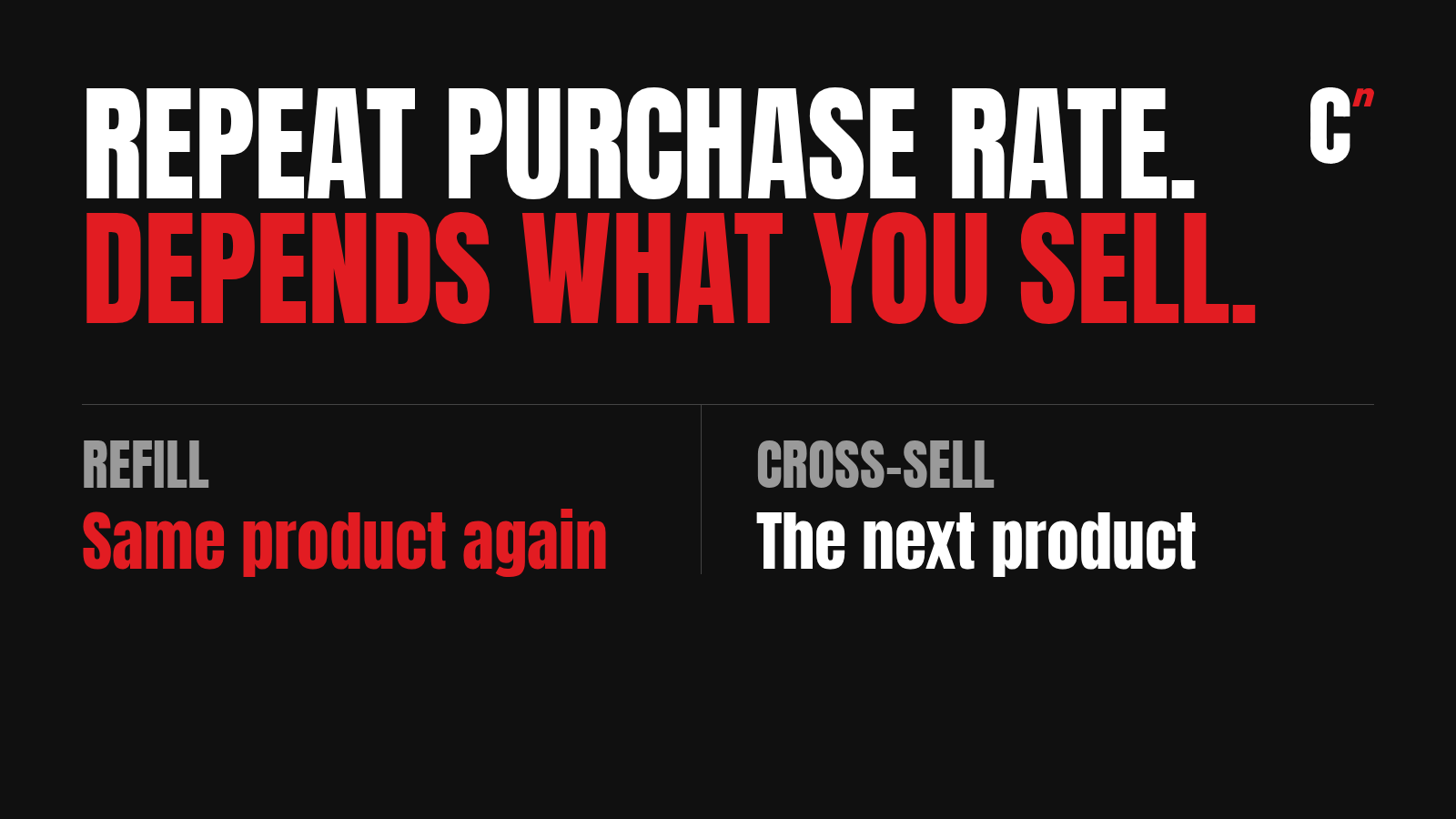
Repeat purchases come in two kinds, and most categories lean towards one.
| Kind of repeat | What the customer buys again | How often | Examples |
|---|---|---|---|
| Refill | The same product, because it ran out | On a clock, every few weeks or months | Protein, supplements, skincare, coffee, pet food |
| Cross-sell | A different product from the same brand | When they need the next thing | Cookware, furniture, jewellery, electronics |
Refill brands should expect the higher end of the range. The repeat is built into the product. If a tub of protein lasts a month, a customer who liked it has a reason to come back in about 30 days. At HealthifyStore, moving revenue towards the products that run out, protein and supplements, meant more of each month's revenue came from customers we already had.
Cross-sell brands should expect the lower end, and that isn't a failure. Nobody buys a second cast iron pan of the same size. At Cumin Co, repeat came from the next product. Someone who bought a tawa was shown a pan, someone who bought a pan was shown a kadai, and so on through the range. Colour worked the same way, so a customer who bought a piece in one colour was shown other pieces in that colour. That takes longer and needs a reason, so a 12-month rate will read lower than a refill brand's.
Many brands are both. HealthifyStore sold refills like protein and one-time products like smart scales, and the smart scale buyer only repeated through a cross-sell. If your catalogue mixes the two, measure them separately.

The period you measure changes the number
Repeat purchase rate is always "within a period", and the period changes the answer. Measure a refill brand over 30 days and most customers haven't run out yet. Measure a cookware brand over 90 days and almost nobody has needed the next product.
Pick a window long enough for a customer to need you again. For products that run out in a month, three months works. For slower categories, use six months to a year. Then compare like with like, the same window this year against last year, never your 90-day number against someone else's annual one.
The cleanest way is to follow one group of customers. Take everyone whose first order fell in the same month, and count how many have ordered again since. That's the cohort method the calculator uses, and it isn't affected by how many new customers you won in other months.
The benchmark that travels: new versus returning customers
Every category can track one number the same way. Of the customers who bought from you this month, how many had bought before, and how many were new? Shopify shows this as returning customer rate.
It's a useful health check, with one catch. It moves with your ad spend.
At HealthifyStore, when we stopped spending on new customers, the share of orders from returning customers rose sharply. Nothing about loyalty had changed. The same loyal customers kept buying, there were simply fewer new ones diluting the number. The reverse happens during a big sale, when a flood of new customers makes the returning share fall even if your regulars bought as usual.

So read the new-versus-returning mix next to your ad spend for the same month. If the returning share rose because acquisition fell, that's not a retention win. If it rose while you kept acquiring at the same pace, it is. For the true picture of whether new customers come back, use the cohort rate.
Repeat purchase rate vs retention rate vs returning customer rate
These three get mixed up constantly. They answer different questions.
| Metric | The question it answers | How it's worked out |
|---|---|---|
| Repeat purchase rate | Of my customers, how many have bought more than once? | Customers with 2 or more orders ÷ all customers in the period |
| Customer retention rate | Of the customers I started with, how many are still buying? | (Customers at the end − new customers in the period) ÷ customers at the start |
| Returning customer rate | Of this month's buyers, how many had bought before? | Returning customers ÷ all customers who bought in the period |
Retention rate is common in subscriptions and apps, where a customer is either active or not. Repeat purchase rate suits D2C, where customers buy when they need to. Returning customer rate is the one on your Shopify dashboard, and the one most affected by ad spend.
How to increase your repeat purchase rate
The levers depend on the kind of repeat your category gets.
For refill products.
- Time reminders to when the product runs out, not to your campaign calendar. At HealthifyStore, anyone who had bought in the last 15 days was left out of reorder campaigns, and we were building replenishment journeys around how long each product lasts.
- Make reordering one tap, from WhatsApp or email straight to a filled cart.
- Offer a subscription for customers who reorder on a fixed rhythm.
For cross-sell products.
- Map the natural next product. By product, like a tawa leading to a pan and a pan to a kadai. And by colour, showing a customer more pieces in the colour they already chose. Send it once the first product has been used, not the day after delivery.
- Teach before you sell. Recipes, care guides and usage tips keep you in the customer's mind for the months between purchases.
- Give the gift angle. A durable product that a customer loves is often bought again for someone else.
For every category.
- Make sure the messages arrive. If your WhatsApp messages aren't delivered, no reminder works. My post on WhatsApp delivery rate covers the fixes.
- Bring back customers who drifted, using their own history rather than a bigger discount. That's how win-back campaigns lifted revenue from lapsed users 79% at Healthify.
- Check what each extra repeat customer is worth. The customer lifetime value calculator shows how a higher repeat rate changes what a customer is worth over time.
The 80/20 rule in ecommerce
The 80/20 rule is the idea that a small share of customers, often said to be about 20%, brings in most of a brand's revenue. It's a rule of thumb, not a law, and the split varies by brand. It's still worth checking in your own data.
Sort last year's customers by what they spent and see what share of revenue the top fifth brought in. If it's high, your repeat buyers matter even more than your repeat rate suggests, and they deserve their own journeys, early access and the first look at new products.
Where I fit
Most brands I look at measure repeat with the wrong window, compare against a benchmark meant for a different category, or read a jump in returning customers as loyalty when ad spend simply fell. Compound Lab is a retention agency, and setting up the right measure and the journeys behind it is the job. Book a 30-minute call and we'll work out what a good repeat rate looks like for your category.
FAQ
What is a good repeat purchase rate? Published benchmarks put it at about 20% to 30% of customers buying again within a year, which is also the usual answer for a good percentage of repeat customers. Refill categories like beauty and supplements usually sit higher, and cross-sell categories like cookware, furniture or electronics lower, so compare against your own category.
How do you calculate repeat purchase rate? Divide the number of customers who bought two or more times in a period by the total number of customers in that period, then multiply by 100. Use a period long enough for customers to need your product again.
What is the difference between repeat purchase rate and retention rate? Repeat purchase rate is the share of customers who have bought more than once in a period. Retention rate is the share of the customers you started a period with who are still buying at the end. D2C brands usually track repeat purchase rate, and subscription businesses retention rate.
What is a good returning customer rate on Shopify? There's no single good number, because Shopify's returning customer rate rises when you acquire fewer new customers and falls during big sales. Track it alongside your ad spend, and use cohort repeat rate to see whether new customers come back.
What is the 80/20 rule in ecommerce? It's the rule of thumb that a small share of customers, often said to be about 20%, brings in most of the revenue. The exact split varies, so check it in your own customer data.
How can I increase my repeat purchase rate? For refill products, time reminders to when the product runs out and make reordering easy. For cross-sell products, map the natural next product and send it once the first has been used. For every brand, make sure messages are delivered and win back lapsed customers with their own purchase history.
Not sure what a good repeat rate is for your category? Book a 30-minute call.

Free planner
Start with the data, not the discount.
The win-back campaign planner. How I find the customer data a win-back message needs, and turn it into words, in one PDF.
- A four-step method to find the data you already hold
- Where that data lives, with real examples from brands I’ve worked with
- A data-to-words worksheet, the four-block message and a results tracker
Sent. Check your inbox.
The planner is on its way to .