
WhatsApp API Pricing in India: Per Message Rates (2026)
WhatsApp API pricing in India after Meta's October 2026 changes: rates per message, what's free, GST, provider markups and a free cost calculator.
Updated October 2026.
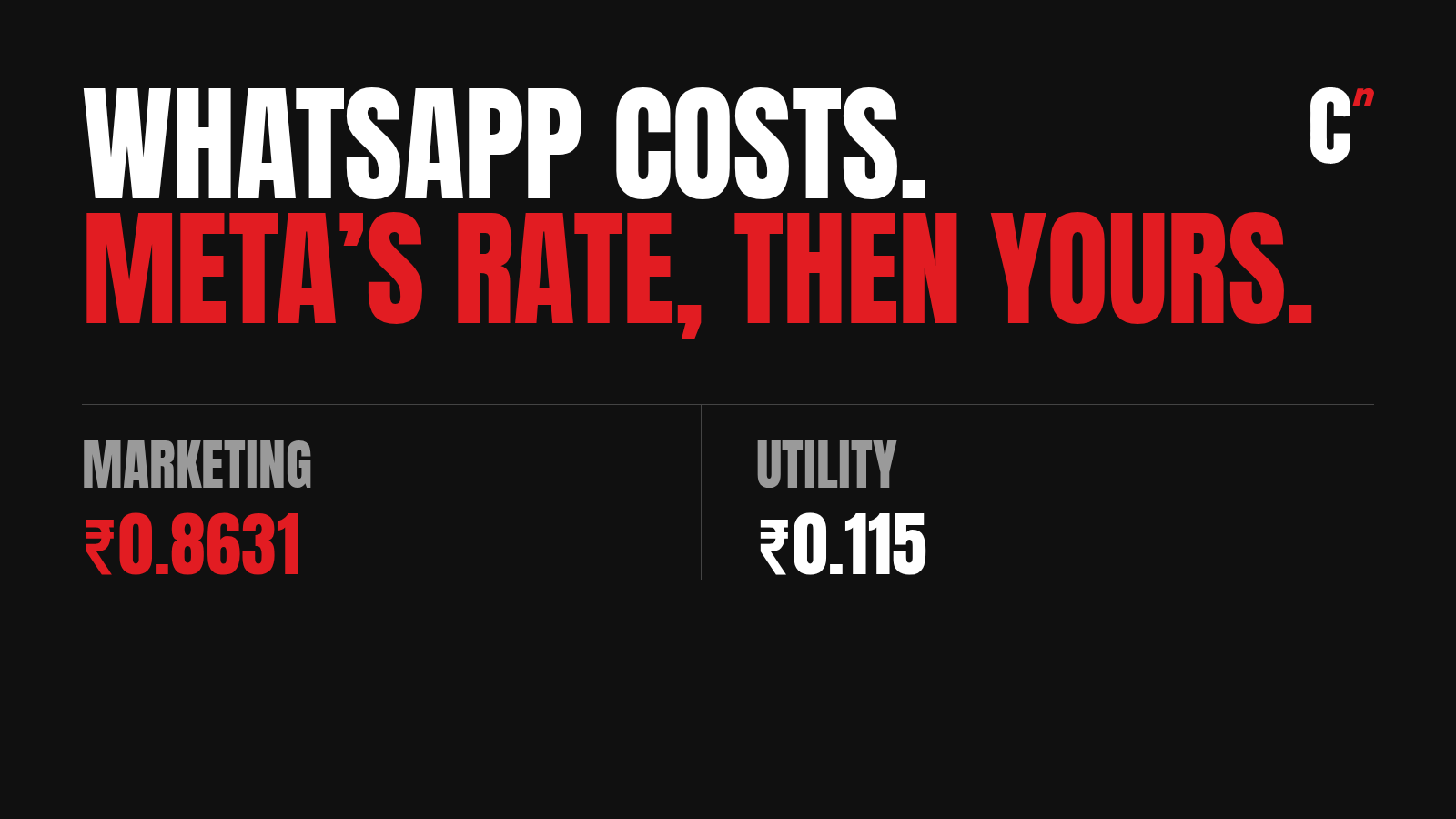
WhatsApp API pricing in India is per delivered message. A marketing message to an Indian number costs ₹0.8631 at Meta's rate, before 18% GST. Utility, authentication and service messages cost ₹0.115 each. Meta charges only for messages that are delivered, and your WhatsApp provider adds its own markup and a monthly fee on top.
So a campaign that reaches 1 lakh people costs about ₹86,300 at Meta's rate, or about ₹1.02 lakh with GST, before your provider's share. These rates took effect on 1 October 2026, along with two changes that make replies and order updates cost more than they did.
I pay these bills every month. I ran WhatsApp for Cumin Co, where we took delivery from 23% to 44% in a month, and I use Kwik Engage today. Here's what WhatsApp actually costs, and how to check what your provider is adding.
WhatsApp Business API pricing in India: Meta's rates
Meta charges per delivered message. The rate depends on two things, the message category and the country of the person receiving it. Messages customers send to you are always free.
The table below shows Meta's list rates for Indian numbers, as of October 2026.
| Message category | What it's for | Meta's rate (before GST) |
|---|---|---|
| Marketing | Offers, broadcasts, cart and win-back reminders | ₹0.8631 |
| Utility | Order confirmations, shipping and delivery updates | ₹0.115 |
| Authentication | One-time passwords | ₹0.115 |
| Service | Replies inside the 24-hour window | ₹0.115, after 1,000 free a month |
Sources: Meta's pricing page and its INR rate card, effective 1 October 2026. Meta can change rates only on 1 January, 1 April, 1 July or 1 October.
Two more things on Meta's rate card. Utility and authentication messages get cheaper in volume tiers, but in India the first discount starts at 2.5 crore utility messages a month, so almost every D2C brand pays the list rate. And replies written by Meta's own AI agent are charged separately, at $2 per million tokens, which Meta estimates at 4 to 5 US cents a message.
Marketing vs utility messages
A marketing message costs about 7.5 times what a utility message does, so the category matters more than anything else on your bill.
Marketing. Anything that promotes, from a sale announcement to a cart reminder with a discount. My abandoned cart flow is all marketing messages, even the first one without an offer, because its purpose is to get a sale.
Utility. Messages about something the customer already did, like an order confirmation, a shipping update or a delivery notice.
Authentication. One-time passwords for login or checkout.
Service. Free-form replies you send inside the 24-hour window, whether a person writes them or a chatbot does.
You choose a category when you submit a template, but Meta reviews it. If a template you submit as utility includes a promotion, Meta can recategorise it as marketing and charge the marketing rate. Keep order updates purely informational, and send the cross-sell as its own marketing message.
What changed on 1 October 2026
Meta made two changes that raise costs for most D2C brands.
- Service messages are charged again. Replies inside the 24-hour window had been free since November 2024. Now every business phone number gets 1,000 free service messages a month, and each one after that costs ₹0.115 in India. Unused free messages don't carry over.
- Utility messages inside the 24-hour window are charged. Since July 2025, an order update sent while a customer's window was open was free. Now it's charged at the utility rate, wherever it's sent.
If you're integrated with Meta directly and based in India, there's a third change. Meta now bills Indian businesses in rupees, and accounts still in dollars have to move to INR by 31 December 2026, after which Meta stops delivering their messages. If you use a provider, they handle this.
The 24-hour rule on WhatsApp Business
When a customer messages you, a 24-hour customer service window opens. Each new message from them resets it to 24 hours.
While the window is open, you can reply with normal messages, like text, images or a chatbot flow. Once it closes, you can only reach that customer with an approved template, and every template is charged by its category.

Since 1 October 2026, the window no longer makes messages free on its own. Replies inside it are free only within your 1,000 a month, and utility templates inside it are charged.
The window also matters for delivery. Meta limits how many marketing messages each person receives based on how they engage, and marketing messages sent inside an open window don't count towards that limit, as I cover in my post on WhatsApp delivery rate.
Is the WhatsApp Business API free?
Access to the API is free from Meta. You pay for messages, and most brands also pay a provider for the platform they send from. A few things are still free.
- Messages customers send you. Always free.
- Your first 1,000 service messages each month, on each business phone number.
- Messages after a click-to-WhatsApp ad. When someone messages you from a click-to-WhatsApp ad on their phone and you reply in time, Meta opens a free entry point window, and marketing, utility and service messages sent in it are free. Providers including Kwik Engage and AiSensy describe this window as 72 hours. Meta's own pricing page now says it can stay open for up to 7 days, so check with your provider how they apply it.
Some providers advertise a free plan. These usually cover the platform, not Meta's message charges, and may not include broadcasts.
How much does it cost to send 1 lakh WhatsApp messages?
At Meta's rates, with 18% GST, before any provider markup:
| Messages delivered | Marketing | Utility |
|---|---|---|
| 10,000 | ₹8,631 + GST = ₹10,185 | ₹1,150 + GST = ₹1,357 |
| 1 lakh | ₹86,310 + GST = ₹1,01,846 | ₹11,500 + GST = ₹13,570 |
| 10 lakh | ₹8,63,100 + GST = ₹10,18,458 | ₹1,15,000 + GST = ₹1,35,700 |
These are delivered messages. If you send 1 lakh marketing messages and 80% are delivered, Meta charges for 80,000, which is ₹69,048 before GST. Low delivery doesn't cost you money directly, but it means fewer people saw the message you paid to write.
To send 10,000 or more messages at once, you need the WhatsApp Business API through a provider, approved templates, and customers who have opted in. The WhatsApp Business app on your phone isn't built for it. WhatsApp also limits how many people a new number can message in a day, and the limit rises as your number keeps a good quality rating.
What a D2C brand really pays per month
Meta's rates are only part of the bill. Here's what I pay on Kwik Engage, from the plan details in my own dashboard in October 2026. A platform fee of ₹9,000 a month, then ₹0.96 per marketing message, ₹0.20 per utility or service message and ₹0.22 per authentication message, before GST. I'm a paying customer, with no partner or referral arrangement with GoKwik.
Compared with Meta, that's 11% more on marketing messages, 74% more on utility and service, and 91% more on authentication. So a provider can be close to Meta's rate on one category and well above it on another, and the only way to see it is to compare category by category.
Here's what that means for a month at a growing D2C brand. The message volumes are illustrative, and the rates and platform fee are mine.
| Item | Messages | At Meta's rates | At my Kwik Engage rates |
|---|---|---|---|
| Marketing (30,000 sent, 85% delivered) | 25,500 | ₹22,009 | ₹24,480 |
| Utility | 20,000 | ₹2,300 | ₹4,000 |
| Service (1,000 free) | 4,000 paid | ₹460 | ₹800 |
| Messages total | ₹24,769 | ₹29,280 |
The provider adds ₹4,511 a month on messages, 18% over Meta, which is about ₹54,000 a year. Add my ₹9,000 platform fee and 18% GST, and the month's bill is ₹45,170. If WhatsApp brought in 400 orders that month, each one cost about ₹113 in messaging.

Kwik Engage's AI chatbot costs about ₹10,000 a month more, and Kwik Engage charges it once per customer per 24 hours, on top of Meta's charge for each message the bot sends. My Kwik Engage review covers what the platform fee includes.
For a quick estimate with your own numbers, use the WhatsApp cost calculator. Enter roughly how many messages you send and your provider's rates, and it shows what they cost at Meta's rates and how much more you're paying.
WhatsApp API pricing by provider
Providers charge in one of two ways. Some publish a rate per message that includes their markup, plus a monthly plan. Others pass Meta's rate through and charge a higher platform fee. The table below shows what three providers charge, as of October 2026.
| Provider | Monthly plan | Rate per message in India |
|---|---|---|
| AiSensy | Free plan without broadcasts; paid plans from ₹1,500 | Marketing ₹1.09; utility, authentication and service ₹0.145 |
| Wati | From ₹2,699, billed quarterly | Published on its rate card |
| Kwik Engage | ₹9,000, what I pay | My account: marketing ₹0.96; utility and service ₹0.20; authentication ₹0.22 |
Sources: AiSensy's pricing page and Wati's pricing page, checked October 2026, and my own Kwik Engage billing dashboard. Kwik Engage shows rates per account rather than publishing them, so yours may differ. Plans and rates change, so confirm yours before you sign.
AiSensy's page doesn't say whether its message rates include GST. If ₹1.09 is before GST, it's 26% above Meta's ₹0.8631. If it includes GST, it works out to ₹0.92 before tax, about 7% above Meta. That gap is why the first thing to ask any provider is whether their rate includes GST.
Before you sign, ask these four questions.
- What is your rate per message for each category, before GST? Compare each one with Meta's rate above.
- Do you charge for delivered messages or sent messages? Meta charges only for delivered ones.
- What does the monthly fee include? Check users, automations, integrations and analytics.
- Do chatbot or AI replies cost extra? Many providers charge for these separately, on top of Meta's service rate.
My guide to choosing a CRM platform covers the rest of what to compare.
How to spend less on WhatsApp
- Send to people who read. Meta limits marketing messages to people who don't engage, and broadcasting to them lowers delivery for everyone. Error 131049 is the sign you're sending too much.
- Use journeys, not blasts. A message triggered by what someone just did gets read far more often than a broadcast, so each rupee reaches someone who cares.
- Keep utility messages utility. An order update with a discount code slipped in gets charged at the marketing rate, 7.5 times higher.
- Use click-to-WhatsApp ads for first conversations. Messages in the free entry point window cost nothing from Meta.
- Check your provider's markup once a year. At scale, a few paise per message adds up to lakhs.
The cheapest message is one that brings in a sale. Judge WhatsApp by cost per order and by what customers spend over time, not by the price of one message. The customer lifetime value calculator helps with the second part.
Where I fit
Most WhatsApp bills I look at have the same problems, too many broadcasts to people who stopped reading, and order updates paying the marketing rate. Compound Lab is a retention agency that runs WhatsApp marketing for D2C brands, and fixing that is the job. Book a 30-minute call and we'll go through your WhatsApp bill and what each order is costing you.
FAQ
How much does a WhatsApp marketing message cost in India? Meta charges ₹0.8631 per delivered marketing message to an Indian number, before 18% GST, as of 1 October 2026. Providers add their own markup, so the rate on your invoice is usually higher.
Is the WhatsApp Business API free? Access to the API is free, but Meta charges for each delivered template message. Messages customers send you are free, as are the first 1,000 service messages a month on each number and messages in the free entry point window after a click-to-WhatsApp ad.
How much does it cost to send 1 lakh WhatsApp messages? At Meta's rate, 1 lakh delivered marketing messages cost ₹86,310 before GST, or ₹1,01,846 with 18% GST. The same number of utility messages costs ₹11,500 before GST. Provider markups and fees come on top.
What is the 24-hour rule on WhatsApp Business? When a customer messages a business, a 24-hour customer service window opens and resets with each new message. Inside it, the business can send free-form replies. Outside it, only approved template messages can be sent, and each is charged by category.
What is the difference between marketing and utility messages on WhatsApp? Marketing messages promote something, like an offer or a cart reminder, and cost ₹0.8631 in India. Utility messages are about something the customer already did, like an order or delivery update, and cost ₹0.115. Meta can recategorise a utility template as marketing if it includes a promotion.
Is there a WhatsApp API in India? Yes. The WhatsApp Business Platform, often called the WhatsApp API, works for Indian businesses and Indian numbers, and Meta publishes rupee rates for it. Most brands use it through a provider such as Kwik Engage, AiSensy, Wati or a CRM platform, since Meta's own Cloud API needs developer setup.
How can I send 5,000 WhatsApp messages at once? Through the WhatsApp API, using an approved marketing template sent as a broadcast from your provider or CRM. The WhatsApp Business app's broadcast lists are capped at 256 contacts and only reach people who saved your number. On the API, a new number starts with a daily limit on how many people it can message, and the limit rises as you keep sending messages people don't block or report.
Are WhatsApp service messages free? Not any more. From 1 October 2026, each business phone number gets 1,000 free service messages a month, and each one after that costs ₹0.115 in India.
Not sure what your WhatsApp is really costing per order? Book a 30-minute call.
Free audit
Watch delivered, not opened.
The WhatsApp delivery audit. The checks I ran at Cumin Co, from reading error codes to frequency, replies and retries, in one PDF.
- How to read 131049 and five other failure codes
- Checks on trust, replies, frequency, journeys and retries
- A grid to score every message, and an 8-week tracker
Sent. Check your inbox.
The audit is on its way to .