
Welcome Email Series and Pop-ups for Ecommerce (2026)
How to plan a welcome email series and the pop-up that starts it: what each message does, when to offer a code, and the rules that stop code hunters.
Updated October 2026.
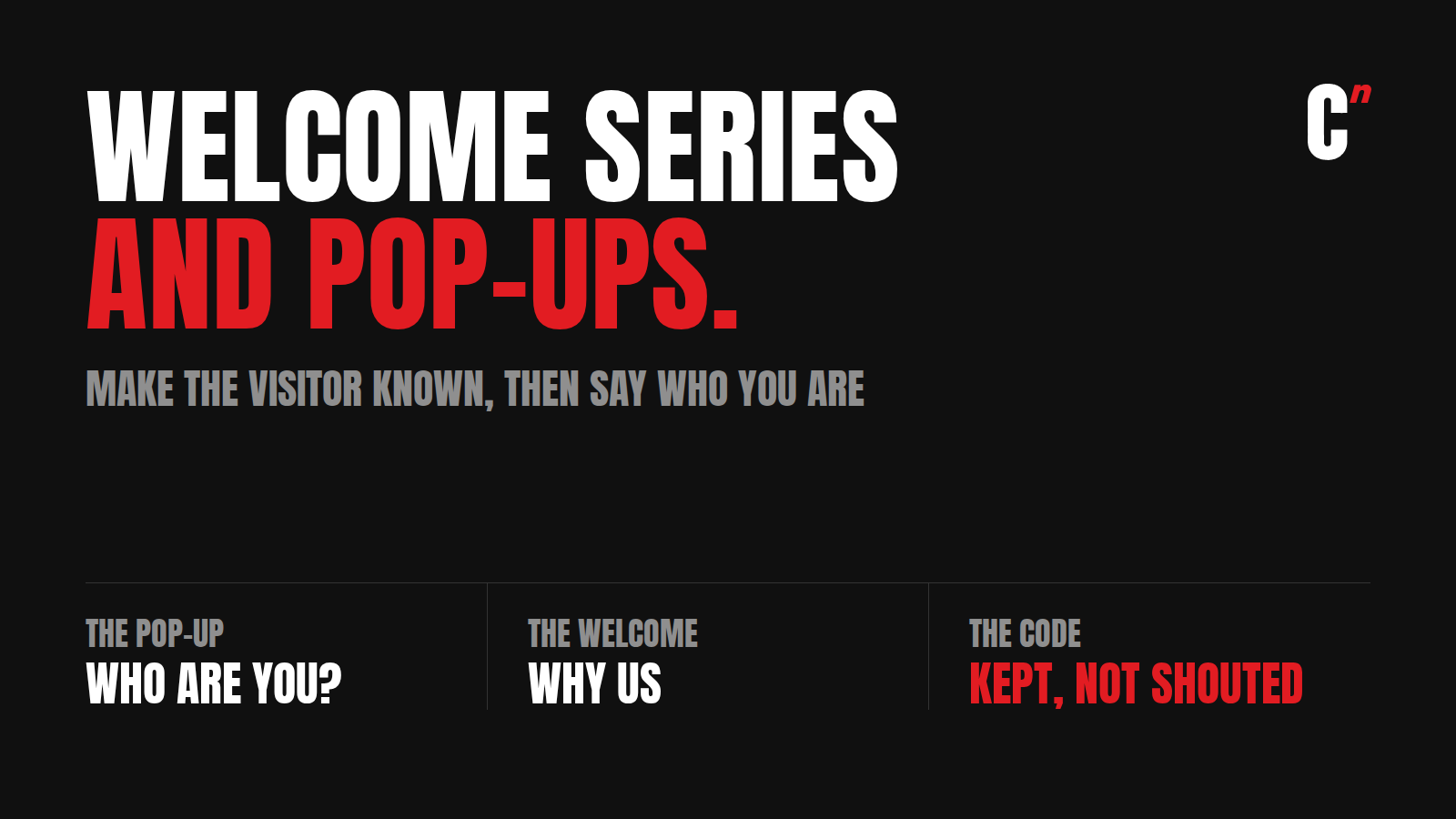
A welcome email series is the set of messages a new subscriber gets in their first week, sent automatically after they sign up. For an ecommerce brand it usually runs three or four messages, by email and WhatsApp. Its job is to answer the question every new subscriber has and never asks: who are you, and why should I buy from you rather than the brand in the next tab?
The pop-up is where it starts. A visitor who leaves without telling you who they are can never be followed up. So the pop-up's real job isn't to hand out a discount. It's to make an anonymous visitor known, so every journey after it has someone to talk to.
I run Compound Lab, a retention agency, and I've worked on pop-ups and welcome journeys for D2C brands, including PNG Jewellers. This guide covers both halves: the pop-up and the series it feeds. It's one of the 13 journeys in my guide to ecommerce automation flows.
The pop-up: make the visitor known
At PNG Jewellers, the first number I checked every morning was pop-up conversion against yesterday. Then WhatsApp against yesterday, then the revenue tracker. The order matters. If the pop-up converted fewer visitors, every journey below it, from welcome to cart recovery, ran on fewer people that day.
There are four ways to learn who a visitor is:
| Method | What the visitor does | Trade-off |
|---|---|---|
| Discount pop-up | Gives a number or email for a first-order code | Converts well, but trains people to expect a code |
| Quiz or product finder | Answers a few questions and gives a contact to see results | Fewer sign-ups, much better data |
| One-tap identity tool | Nothing. Tools like GoKwik's KwikPass or Shopflo's ShopPass recognise shoppers already known in their network | No form, but you're relying on a network |
| Checkout | Types their details | Highest intent, but it comes last |
Most pages on pop-ups push the discount. Shopify, citing Wisepop data, says pop-ups with a discount get 123% more sign-ups than those without. That's a real effect. The cost shows up later, in two places.
Returning customers catch first-order codes. One-tap login tools recognise people who have bought before. If your pop-up or welcome journey doesn't check order history, loyal buyers learn to hunt for the new-customer code.
One shared code leaks. A code like FIRSTORDER ends up on coupon sites. Use a unique code per sign-up, valid for a limited time.
Pop-up rules I set
- Don't block the page on mobile the moment it loads. Give people a few seconds or a scroll first. Google's guidance on intrusive interstitials says overlays that cover the content frustrate people and can hurt search performance, and suggests small banners instead.
- Ask for the phone number in India. WhatsApp usually reaches people that email doesn't. Ask for email as a second field, or later.
- Get WhatsApp opt-in properly. Meta's opt-in rules ask that the opt-in names your brand and makes clear the person is agreeing to messages. A number typed into a form isn't consent by itself.
- Don't show it to known customers. Anyone recognised as a past buyer should see something else, or nothing.
- Use exit intent on desktop, where it's reliable. On mobile, a scroll or time trigger works better.
The welcome series: answer "who are you?"
The person who just signed up hasn't shown interest in a product yet. They were looking around and gave their contact before you gave them a reason to trust you. So the welcome series introduces the brand: its philosophy, its purpose, why it makes things the way it does. It isn't a sales sequence with a story attached.
A welcome series I'd build for a D2C brand has four messages over about a week:
| Message | When | Job |
|---|---|---|
| 1 | Right after sign-up | Thank them, keep any promise the pop-up made, and say in one line why the brand exists |
| 2 | About two days later | The story: who's behind it, how the product is made, what it won't compromise on |
| 3 | About four days in | Proof and help choosing: reviews, bestsellers, or a guide to picking the right product |
| 4 | About a week in | A warm reminder, and the code's expiry if there is one |
Each message goes only if they haven't ordered since the last one.
Keep the promise, inside the story
If the pop-up promised a code, message 1 has to deliver it. But how you deliver it decides what kind of customer you're building. "Here's your 10%, use it now" teaches them the brand is about the discount. "Welcome. Here's a little something for your first order, and here's why we started" teaches them the brand is about something.
Hi Ananya, welcome to Brand.
We started Brand because one line on why the brand exists.
As promised, here's 10% off your first order: code, valid for 7 days.
Button: Explore the range
That's an illustrative brand, not a client. The structure is what matters: welcome, why, then the promise.
Which channel for which message
Message 1 can go on WhatsApp if they opted in there, because they're expecting the code. The rest work better as email, where there's room for a story and pictures. Welcome is low intent, so I don't spend several WhatsApp marketing messages on someone who hasn't looked at a product yet. Meta charges ₹0.8631 for each delivered marketing message in India, before GST.
Welcome journey rules
| Rule | Setting |
|---|---|
| Who enters | New contacts with no past order and no earlier journey |
| When | Sign-up, then about 30 minutes with no deeper action |
| Runs | Once per person, ever |
| Exits | A deeper journey starts (product, cart, checkout), an order, a reply, an opt-out |
| Measure | First orders from entrants, against a small holdout who got nothing |
Welcome closes when a deeper journey starts. Someone who signs up and adds to cart has shown enough intent for the cart journey. Sending them "here's who we are" alongside "your cart is saved" is two brands talking at once.
Once only. A returning customer recognised by a login tool, or someone who already went through it, skips welcome entirely.
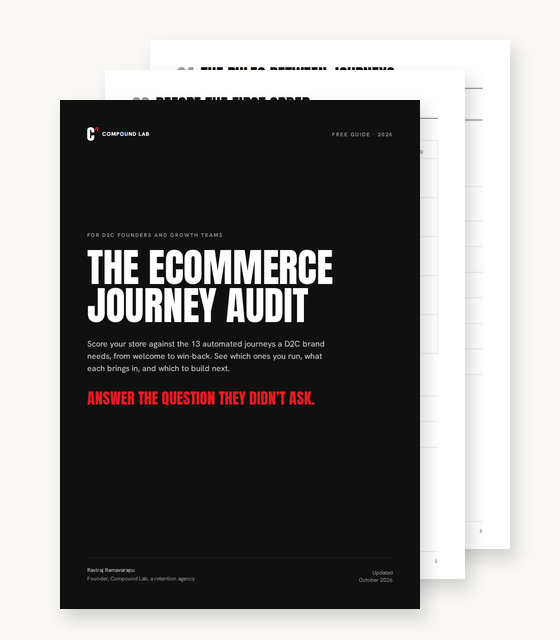
Free auditScore your store against all 13 journeys and pick which to build next, in one fillable PDF. Get the free audit
Welcome email template
Here's a template for the four messages, written for an illustrative brand. Swap the words in bold for your own. Keep each email to one job.
Email 1: welcome and the promise
- Subject: Welcome to Brand. Here's your 10% off
- Preview text: And the one reason we started
- Body: Thank them. One sentence on why the brand exists. The code, its expiry, and one button to the range.
Email 2: the story
- Subject: Why we make product the hard way
- Preview text: The part most brands skip
- Body: Who's behind the brand, how the product is made, and the one thing you won't compromise on. A photo of the people or the process, not a banner.
Email 3: proof and help choosing
- Subject: What 12,000 customers picked first
- Preview text: And how to choose yours
- Body: Your bestsellers or a short guide to picking the right product, with real reviews and your return terms said plainly.
Email 4: a warm reminder
- Subject: Your welcome code ends tomorrow
- Preview text: No pressure. Here if you need help
- Body: A short note, the code's real expiry, and an invitation to reply with any question.
If the brand doesn't give a welcome code, drop the code from emails 1 and 4 and make email 4 about help choosing.
Welcome email examples: what good ones do
I won't paste other brands' emails here; galleries of those are easy to find. What I look for when I audit one:
- A reason the brand exists, in the first message. Not a mission statement. One plain sentence.
- One job per message. A story email that also lists 12 bestsellers and a discount does none of the three well.
- Real proof. Review counts, return terms, the material or ingredient, said plainly. If those aren't strong yet, fix them before writing the email.
- A way to reply. "Reply to this email" or a "Chat with us" button often surfaces the question that was stopping a first order.
- No countdown that resets. People notice, and remember.
How to measure a welcome series
Measure first orders from people who entered the journey, against a holdout of about 5% who got nothing. Without the holdout, the welcome series takes credit for every order a new subscriber would have placed anyway. My guide to the holdout group covers how to size it.
Track the pop-up separately: sign-up rate by device, and how many sign-ups are past customers. If that second number is high, your first-order code is going to the wrong people.
What other welcome series guides get wrong
| What many guides say | What's closer to true |
|---|---|
| Lead with the discount. | Keep the promised code, but inside the story. Lead with why the brand exists. |
| Send the welcome series to every new subscriber. | Skip past buyers and anyone already in a deeper journey. |
| More messages, more sales. | Low intent means fewer, better messages. Save WhatsApp for the one they expect. |
| Pop-ups exist to collect emails. | In India, collect the phone number with a proper WhatsApp opt-in. The pop-up's job is to make a visitor known. |
| Use one welcome code for everyone. | Use unique, time-limited codes so they don't end up on coupon sites. |
Where I fit
Most welcome journeys I audit are one email with a discount, sent to everyone, including past customers. Compound Lab is a retention agency, and building the pop-up, the welcome series and the journeys that follow is the work. Book a 30-minute call and we'll look at what your new subscribers are hearing from you.
FAQ
What is a welcome email series? A set of automated emails sent to a new subscriber in their first days, usually three to five over about a week. It introduces the brand, keeps any promise made at sign-up, and helps them choose a first product.
How many emails should a welcome series have? Three or four is enough for most D2C brands. Each one should have a single job: welcome and the promise, the brand story, proof and help choosing, and a final reminder.
When should I send the first welcome email? Straight after sign-up, especially if the pop-up promised a code. People expect it within minutes.
Is there a welcome email template I can use? Yes. Four emails cover it: a welcome with any promised code, the brand story, proof and help choosing, and a warm reminder. The template on this page gives a subject line, preview text and outline for each.
What should a welcome message for new customers say? Thank them, say in one line why the brand exists, deliver anything you promised at sign-up, and give them one clear next step. Keep the discount, if there is one, inside that welcome rather than leading with it.
Should a pop-up offer a discount? It raises sign-ups, so many brands do. Use a unique, time-limited code, hide the pop-up from past customers, and present the code as a welcome, not the reason to buy. A quiz or product finder is a good alternative for brands that don't discount.
What is a good email pop-up conversion rate? It varies widely by traffic source, device and offer, and most published figures come from pop-up tool vendors. Track your own rate daily against yesterday and last week, and act on changes.
Can I send welcome messages on WhatsApp? Yes, if the subscriber opted in to WhatsApp messages from your brand. Use WhatsApp for the first message, which they're expecting, and email for the rest.
Free audit
Answer the question they didn’t ask.
The ecommerce journey audit. Score your store against the 13 journeys a D2C brand needs, and pick which to build next, in one PDF.
- A scorecard for all 13 journeys, from welcome to price drop
- The rules that stop journeys from clashing, as a checklist
- Channel costs at Meta’s India rates, and a build-next planner
Sent. Check your inbox.
The audit is on its way to .