
Ecommerce Automation Flows: 13 Customer Journeys for D2C
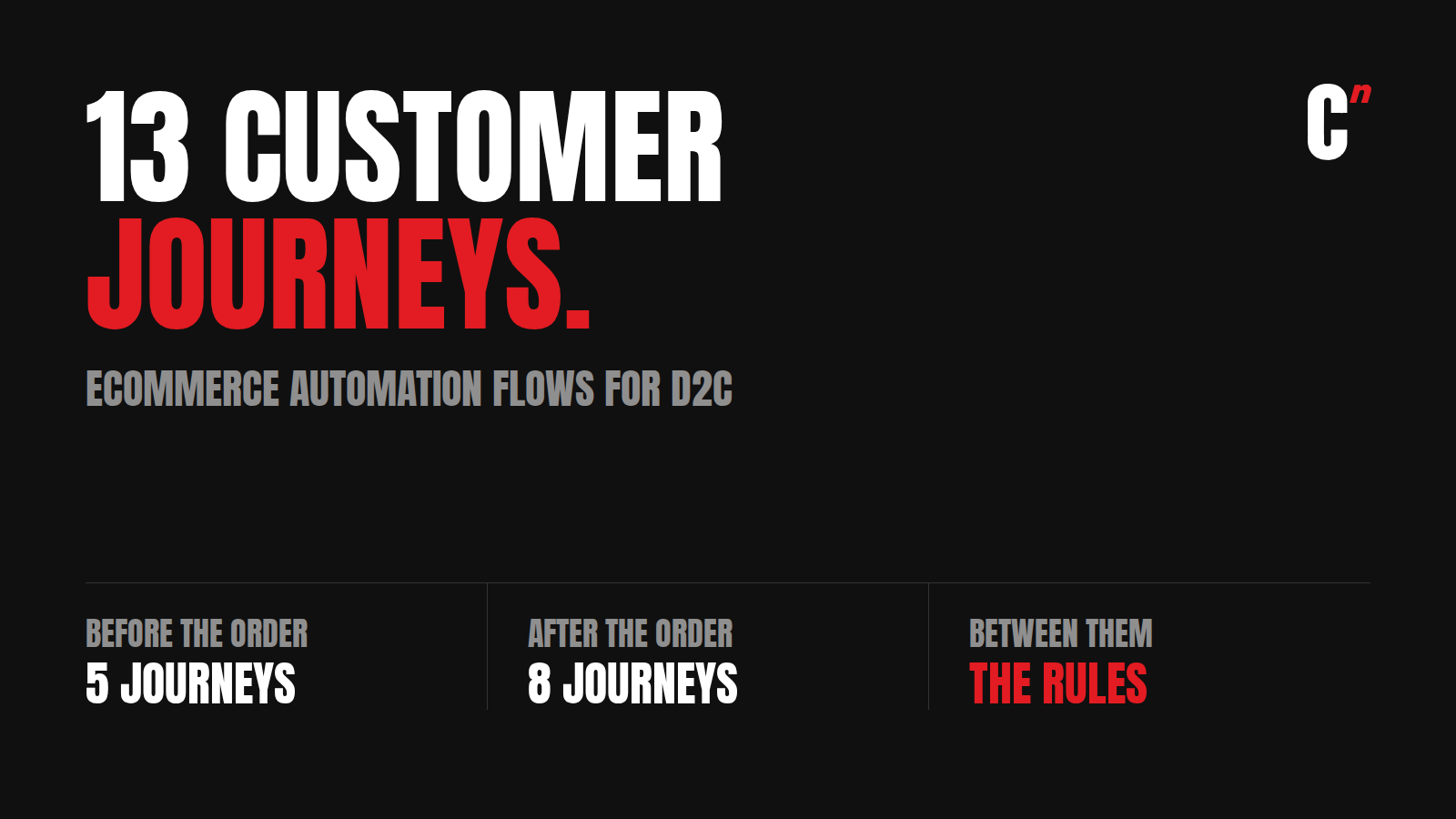
The 13 automated customer journeys a D2C brand needs, from welcome to win-back: what each one is for, when it starts, and which one wins when two clash.
Updated October 2026.
An ecommerce automation flow is a series of messages your store sends on its own when a customer does something, or stops doing something. Someone leaves a cart, so the cart flow starts. An order is delivered, so the post-purchase flow starts. Flows are also called journeys, sequences or automations. In this guide the words mean the same thing.
A D2C brand needs 13 of them: five before the first order and eight after it. Most brands run three (welcome, abandoned cart and a broadcast calendar) and wonder why repeat orders don't move.
I run Compound Lab, a retention agency, and I've built these journeys for brands like PNG Jewellers, Healthify Store and Cumin Co. At PNG Jewellers, automations brought in 77% of CRM revenue and campaigns 23%. That's the case for journeys in one line: they reach people at the moment something happened, so they don't have to shout.
This guide gives the founder's view: what each journey is for, when it starts, what it should and shouldn't do, and the rules that stop journeys from tripping over each other. That last part is the one most guides leave out.
What makes a journey work
Every journey answers a question the customer hasn't asked out loud. A shopper who browsed a collection and left is asking "what have you got?" A shopper who left a full checkout is asking "what just got in my way?" Send the cart message to the checkout leaver and you've answered the wrong question.
So I set up every journey with the same five parts:
- The question. What is this person unsure about right now?
- The trigger. The event that starts it, and how long to wait before deciding they've stopped. For drop-offs before the order, that wait is 30 minutes.
- The job. What the messages have to do, which is usually not "offer a discount".
- The exit. What ends the journey: an order, a deeper action, a reply, an opt-out.
- The measure. What counts as the journey working, checked against a group that got nothing.
The 13 journeys at a glance
| # | Journey | The customer's question | Starts when |
|---|---|---|---|
| 1 | Welcome | Who are you? | A new contact signs up and does nothing deeper for 30 minutes |
| 2 | Collection | What have you got? | They view a collection, open no product |
| 3 | Product (browse) | Will this work for me? | They open a product, don't add it to cart |
| 4 | Cart | Is this worth it, from you, now? | They add to cart, don't start checkout |
| 5 | Checkout | What just got in my way? | They start checkout, don't pay |
| 6 | Post-purchase | Did it arrive, and does it work? | An order is placed |
| 7 | Cross-sell | What goes with it? | The first order has settled, with no second category bought |
| 8 | Upsell | Is there a better way to buy this? | A repeat buyer is due to reorder |
| 9 | Replenishment | Am I about to run out? | A consumable is close to its run-out date |
| 10 | Win-back | Why did I stop? | They've gone well past their usual gap between orders |
| 11 | Loyalty | Do you know who I am? | They become one of your best customers |
| 12 | Back in stock | Is it back? | They asked to be told |
| 13 | Price drop | Is it cheaper now? | A product they carted gets cheaper |

Before the first order: five journeys
These five only work on people you can identify. An anonymous visitor who leaves can't be followed up at all, so the first job is to learn who's browsing. That happens in three ways: a pop-up sign-up, a one-tap identity tool like GoKwik's KwikPass or Shopflo's ShopPass, or the details a shopper types at checkout.
At PNG Jewellers, the first two numbers I checked every morning were pop-up conversion against yesterday and WhatsApp against yesterday. If either fell, every journey below it ran on fewer people.
1. Welcome: "Who are you?"
Someone gave you their number or email but hasn't shown deeper interest yet. They don't know why your brand exists. The welcome journey tells them: the philosophy, the purpose, why the product is made the way it is.
Two rules I hold to. Welcome runs once per person, ever, so returning customers recognised by a login tool don't get a "first order" code. And if the pop-up promised a code, the first welcome message keeps that promise warmly, inside the brand story, rather than shouting "take 10% and buy".
Full guide: welcome email series and pop-ups.
2. Collection: "What have you got?"
This is the journey almost nobody runs. Someone browsed a category, opened nothing, and left. The listing didn't help them choose. Don't send them the whole shelf again. Show them the range, then the best of it. For a whey protein collection, that's the flavours. For earrings, the top five bestsellers, or a link to the collection already filtered by bestseller.
Keep it light: one or two messages. It's the lowest-intent journey of the five.
3. Product: "Will this work for me?"
They opened a product and didn't add it. Usually the page didn't answer something: the size, how it's used, delivery to their pincode, the return terms. Send the answer, not a sales push. Reviews of that exact product. The most asked question about it. What it costs to get it to them, and by when.
Someone who opened the same product twice has a specific doubt. Lead with the answer to it. And read the questions that come back as a fix list for the product page itself.
Full guide: browse abandonment, product and collection journeys.
4. Cart: "Is this worth it, from you, now?"
The product is chosen. What's open is the brand, the value and the timing. I run cart as three messages: a reminder at 30 minutes with no discount, a reason to trust the brand at six hours, and an offer at 21 hours, only if the brand discounts.
I've run that flow at PNG Jewellers, Healthify Store and Cumin Co. The rule that matters most is the exit: the moment someone orders, every reminder stops. Nobody should get a discount an hour after paying full price.
Full guide: abandoned cart recovery on WhatsApp, email and SMS.
5. Checkout: "What just got in my way?"
Checkout drop-offs are about mechanics more than persuasion: a shipping charge that appeared late, a delivery date too far out, a payment that failed. The message should read like service, not marketing: your checkout is saved, here's the total, it reaches you by Thursday, and here's a person on this number if something went wrong.
A discount doesn't fix a broken checkout. If shipping cost was the blocker, a shipping waiver is the targeted fix. If the same blocker keeps showing up, it belongs with the website team, not in more messages. Payment failure is a branch of this journey, sent sooner, with another way to pay.
After the order: eight journeys
The first order is day zero of retention. The second and third orders are where acquisition cost gets paid back, which I show in rupees in CM1, CM2 and CM3.
6. Post-purchase: "Did it arrive, and does it work?"
In India this journey starts before delivery. Order and shipping updates on WhatsApp are utility messages, which Meta charges at ₹0.115 each in India, against ₹0.8631 for a marketing message. A COD order that gets confirmed and tracked is far less likely to come back as RTO.
After delivery, the job is use. A product that isn't used never creates the need for the next one. At Cumin Co, we led with care and seasoning guidance for the cookware each customer had bought.
Full guide: post-purchase emails and WhatsApp for Indian D2C.
7. Cross-sell: "What goes with it?"
Send the natural next product, not the bestseller list. At Cumin Co, the picture I had in mind was a kitchen rack with empty spaces, and the job was to help fill them: a dosa tawa owner towards a Dutch oven, a kadhai owner towards a knife set. At MyGate, residents who booked a cab to the airport were offered the ride home, and return pickups went from 21% to 30%.
Wait until the first order has settled. A cross-sell that lands before the product does feels like a sales list.
Full guide: replenishment and cross-sell flows.
8. Upsell: "Is there a better way to buy this?"
For someone who has bought the same thing more than once, the better offer is a bigger pack, a bundle or a subscription at a standing price. It runs instead of the replenishment reminder, not on top of it, so the customer gets one message about the reorder, not two.
9. Replenishment: "Am I about to run out?"
Time the reminder to when the product runs out, minus delivery time. At Healthify Store, a tub of whey protein lasted about 30 days, so the reminder went out on day 25. Delivery took three to four days, so a customer who ordered on day 25 or 26 had the new tub before the old one ran out.
10. Win-back: "Why did I stop?"
Win-back starts when a customer has gone well past their own usual gap between orders, not a fixed 90 days for everyone. At Healthify, the win-back message stopped leading with a discount and reminded lapsed users of their own progress instead. Revenue from that cohort rose 79%.
Full guides: win-back campaigns and WhatsApp win-back messages.
11. Loyalty: "Do you know who I am?"
Your best customers should feel recognised, not discounted. Early access to launches, a note from the founder, credits on the next order. At Healthify Store, every order earned coins worth 10% of its value, and the messages reminded customers they had coins waiting.
12. Back in stock: "Is it back?"
The one journey people ask for. Send it in batches sized to the stock that came back, so the last people in line don't click through to "sold out" again. At PNG Jewellers, pieces customers wishlisted in one season came back in their messages when that season returned.
13. Price drop: "Is it cheaper now?"
One message, only for products someone carted or reached checkout with in the last few weeks, and only when the price falls by enough to matter.
The rules between journeys
Thirteen journeys running at once will collide unless you decide who wins. These are the rules I set before anything goes live. None of the guides I read on this topic, from tool vendors or agencies, set rules for what happens when two journeys apply to the same person.
| Rule | What it means |
|---|---|
| One journey at a time before the order | The deepest drop-off wins: checkout, then cart, product, collection, welcome |
| Move up, never down | Someone in the product journey who adds to cart moves to cart straight away. A shallower action never pulls them back |
| Order ends everything | No reminder, no discount, after a purchase |
| Reply hands over | A typed reply goes to a person on the same number, and automated messages stop |
| A gap before re-entry | After a journey ends without an order, a lower journey can start only after a few days |
| Order updates always go | Utility messages are never held back or used to sell |
| One incentive before the second order | Recorded on the profile, so nobody gets three first-order codes from three journeys |
| Margin before message | Heavy returners and discount-only buyers skip cross-sell offers |
The gap rule comes from what I saw at Cumin Co. Customers were getting three to four marketing messages a week. Cutting that to two, and leaving anyone who got an automation in the last three days out of broadcasts, was part of how WhatsApp delivery went from 23% to 44% in a month.
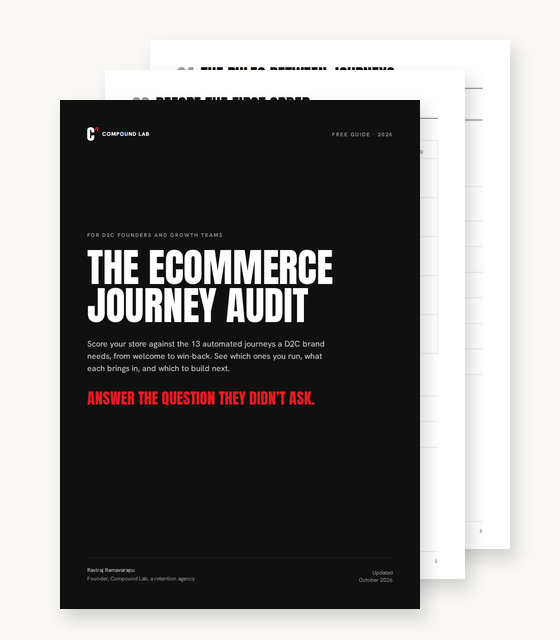
Free auditScore your store against all 13 journeys and pick which to build next, in one fillable PDF. Get the free audit
Which channel for which journey in India
| Journey | First channel | Why |
|---|---|---|
| Welcome, collection, product | Email, then WhatsApp | Lowest intent. Don't spend marketing messages on browsers |
| Cart, checkout | WhatsApp, with email and SMS as fallbacks | Highest intent, and speed matters |
| Post-purchase order updates | WhatsApp utility, SMS fallback | ₹0.115 a message, and it protects delivery |
| Cross-sell, upsell, replenishment | WhatsApp, with email | Timed to a real moment, so worth a marketing message |
| Win-back, loyalty | WhatsApp and email | Personal history carries the message |
| Back in stock, price drop | They asked, or they nearly bought |
Every journey needs a fallback. If WhatsApp isn't delivered or the person hasn't opted in, the same message goes by email, then SMS. Promotional SMS in India also needs DLT-registered templates. The WhatsApp cost calculator shows what your volumes cost at Meta's rates.
How to tell if a journey is working
Opens and clicks don't settle it. Some of the people who ordered after a cart reminder would have ordered anyway. Hold back about 5% of the people entering each journey, send them nothing, and compare orders. My guide to the holdout group and global control group covers how to size it.
Count two things separately. The step forward (a product viewer who added to cart, a cart leaver who reached checkout) tells you the journey moved them. The order tells you it paid. A journey can do the first well and still need a better last message.
And review every journey monthly. Journeys go stale quietly: a product goes out of stock, a price changes, a template gets paused. Nobody notices until revenue from automations dips.
Which journeys to build first
If you're starting from nothing, build in this order:
- Post-purchase order updates. They protect the first delivery, and they're the cheapest messages you'll send.
- Cart and checkout. The highest intent you'll ever see from someone who hasn't bought.
- Welcome. Every pop-up sign-up is otherwise wasted.
- Replenishment or cross-sell, whichever fits your product. Consumables need replenishment; durables need cross-sell.
- Win-back. Once you have enough lapsed customers to matter.
- Product and collection, then loyalty, back in stock and price drop.
The free journey audit turns this into a scorecard for your own store: which of the 13 you run, what each one brings in, and which to build next.
What other guides on ecommerce flows get wrong
| What many guides say | What's closer to true |
|---|---|
| Every flow ends with a discount. | Discounts belong in a few places, once per customer before the second order. Most journeys need an answer, not a code. |
| Browse abandonment is one flow. | A collection browser and a product viewer are asking different questions. Treat them as two journeys. |
| Order confirmations are transactional, so leave them out. | In India they're the cheapest way to cut RTO, and they open the conversation for everything after. |
| Send the flow and measure revenue. | Without a holdout, flows take credit for orders that would have happened anyway. |
| Set it and forget it. | Journeys need rules for which one wins, and a monthly check. |
| Email first, SMS optional. | For Indian D2C, WhatsApp usually leads, with email and SMS as fallbacks. |
Where I fit
Most brands I talk to have a CRM tool, a WhatsApp provider and a pop-up. What they don't have is the system that decides who gets which journey, when, and what happens when two overlap. Compound Lab is a retention agency, and that's the work: map the journeys you need, build them in the tool you already have, and check each one against a holdout. Book a 30-minute call and we'll look at which of the 13 your store is missing.
FAQ
What are ecommerce automation flows? They're series of messages a store sends automatically when a customer takes an action or stops taking one, such as signing up, leaving a cart, receiving an order or not reordering. They're also called journeys, sequences or email automations.
What email automation flows does an ecommerce store need? Five before the first order (welcome, collection, product, cart and checkout) and eight after it (post-purchase, cross-sell, upsell, replenishment, win-back, loyalty, back in stock and price drop). Start with order updates, cart and checkout, and welcome.
What is the difference between a flow and a campaign? A flow is triggered by what one customer does and runs on its own. A campaign is sent to a list at a time you choose. Flows usually earn more per message because they arrive at a relevant moment. See flows vs campaigns.
What are the stages of the ecommerce customer journey? Before the first order: discovery, sign-up, browsing, cart and checkout. After it: delivery and first use, the second order, repeat buying, and either loyalty or lapse. Each stage has its own automated journey.
How many messages should an automation flow have? Fewer than you think. Low-intent journeys like collection browsing need one or two. Cart and checkout usually need three. Each message should go only if the customer hasn't acted since the last one.
Can I run these flows on WhatsApp? Yes, with the customer's opt-in. In India, WhatsApp usually leads for cart, checkout, order updates and replenishment, with email and SMS as fallbacks. Marketing messages cost ₹0.8631 each and utility messages ₹0.115, before GST, as of October 2026.
Which automation flow makes the most money? For most D2C brands, cart and checkout recover the most per message, and post-purchase journeys build the most over time because they lead to the second order. Check your own numbers against a holdout before deciding.
Do I need an expensive CRM to run these? No. Most CRM and WhatsApp tools used by Indian D2C brands can run all 13. What matters is that the tool receives the right events (product viewed, added to cart, checkout started, order delivered) and can retry failed WhatsApp messages. My CRM buyer's guide covers how to choose.
Free audit
Answer the question they didn’t ask.
The ecommerce journey audit. Score your store against the 13 journeys a D2C brand needs, and pick which to build next, in one PDF.
- A scorecard for all 13 journeys, from welcome to price drop
- The rules that stop journeys from clashing, as a checklist
- Channel costs at Meta’s India rates, and a build-next planner
Sent. Check your inbox.
The audit is on its way to .