
Post-Purchase Flow for D2C: Emails and WhatsApp (2026)
The post-purchase flow for Indian D2C brands: order and COD confirmation, delivery updates, first use, review requests, and what each costs on WhatsApp.
Updated October 2026.
A post-purchase flow is the set of messages a customer gets between placing an order and deciding whether to order again. It covers order and shipping updates, help using the product, a check-in, and a review request. Most guides treat the first half as "transactional" and leave it out. In India, that first half is where the second order is won or lost, because an order that never arrives can't be reordered.
The question the customer is asking is simple: did it arrive, and does it work? This guide covers how I answer it, step by step, with what each message costs on WhatsApp. It's one of the 13 journeys in my guide to ecommerce automation flows.
I run Compound Lab, a retention agency. The stories below come from brands I've worked at or with: Cumin Co, Healthify Store and Zymrat.
The post-purchase flow, step by step
| Step | When | Job | Message type on WhatsApp |
|---|---|---|---|
| Order confirmation | Right after the order | Confirm what, how much, and when it arrives | Utility |
| COD confirmation | Right after a COD order | Confirm the order and address before you ship | Utility |
| Shipped and out for delivery | As they happen | Keep the promise visible | Utility |
| Delivered, with first use | On delivery | Help them use it well | Utility, if it's about this order and has no promotion |
| Check-in | A few days after delivery | Find problems before they become returns or bad reviews | Utility |
| Review request | About a week after delivery | Ask happy customers to say so publicly | Marketing |
Each step after delivery goes only if nothing has gone wrong. A customer who started a return or said "not for me" gets a person, not a review request.
Before delivery: protect the first order
Order and COD confirmation
Every order gets a confirmation with the product, the total and a delivery date. For cash on delivery orders, the confirmation also asks the customer to confirm the order and the address, with a button.
That button matters more than it looks. When Zymrat, an activewear brand I worked with, switched COD on, RTOs climbed. When we checked, people were giving random addresses. Every one of those parcels cost freight out and freight back, for nothing. A COD order that nobody confirms is a signal to hold it, call, or cancel before it ships.
One rule to know: a utility message can't carry promotion. Meta categorises templates by their content, and an offer to switch from COD to prepaid for a discount is promotional. Send that as a separate marketing message, or put the prepaid incentive at checkout where it belongs. Tools like GoKwik's checkout let you set discounts by payment method.
Order confirmation email: what to include
The order confirmation is the most opened message most brands send, and most use the default. A good one, by email and on WhatsApp:
| Include | Why |
|---|---|
| Product names, images, quantities and the total paid | They check it straight away |
| Payment method, with COD clearly marked | A COD buyer knows to keep cash or UPI ready |
| Delivery address | A wrong address caught now saves an RTO later |
| An expected delivery date, not "5 to 7 days" | A date sets a promise they can plan around |
| How to get help, on the same WhatsApp number | Questions go to a person, not a dead inbox |
| What happens next | "We'll message you when it ships" |
Leave out cross-sells and discount codes. They turn a utility message into a marketing one on WhatsApp, and on email they distract from the one thing the customer opened it to check.
Shipping and delivery updates
Shipped, out for delivery, delivered. These are the cheapest messages you'll ever send, and they do two jobs. They cut "where is my order" calls, and they keep a COD customer expecting the parcel, which makes them more likely to be home and to pay.
What the updates cost
Meta charges ₹0.115 for each delivered utility message in India, against ₹0.8631 for a marketing message, before GST, as of October 2026. A full set of five order updates costs under ₹0.60. A single RTO costs freight both ways. In my CM1, CM2, CM3 guide, the example brand loses ₹180 in two-way freight on every order that comes back. The updates pay for themselves if they save one RTO in a few hundred orders.
After delivery: get it used
A product that isn't used never creates the need for the next one. A tub of whey that sits unopened won't be reordered. A cast iron pan that rusts after the first wash won't lead to a second pan.
At Cumin Co, we led with service: care and seasoning guidance for the cookware each customer had bought. Cast iron needs looking after in a way a non-stick pan doesn't. Those useful messages earned clicks even from people who had stopped engaging, and a customer who keeps cooking with the pan is the one a cross-sell can reach later.
What to send on delivery depends on the product:
- Consumables: how to use it, how much, and how long it lasts. That last part sets up the replenishment reminder.
- Durables: care, setup, the first thing to try.
- Apparel and jewellery: fit, care, how to style it.
Keep it about the order. "Here's how to season your new pan" is about the order. "Here's how to season your pan, and 20% off a Dutch oven" isn't, and turns a utility message into a marketing one.
The check-in
A few days after delivery, ask how it's going, with buttons: loving it, not for me, need help. The buttons sort customers without anyone typing.
- Loving it goes on to the review request.
- Not for me and need help go to a person, and marketing messages pause until it's resolved. This is how you hear about a problem before it becomes a return or a one-star review.
Watch satisfaction alongside use. In my experience, when people stop using a product, their Net Promoter Score drops. Ask for it once they've had time to use the product, and follow up with the ones who score low.
The review request
Ask about a week after delivery, once they've had time to use it, and only if the check-in didn't flag a problem. Ask for a review of the exact product they bought, with a link straight to its review form.
A review request message I'd write for an illustrative brand:
Hi Rahul, it's been a week with your cast iron kadhai.
If it's earning its place in your kitchen, would you tell other cooks? It takes a minute, and it helps a small brand more than you'd think.
Button: Review my kadhai
And if they haven't replied after a few days, one reminder by email, then stop.
Two rules:
- Never ask only happy customers on public platforms in a way that hides unhappy ones. Ask everyone who didn't report a problem, and send the ones who did to support. Some review platforms have their own rules on this, so check yours.
- Don't trade discounts for reviews. It makes the reviews worth less to the next shopper.
Rules for the post-purchase journey
| Rule | Setting |
|---|---|
| Order updates | Always go. Never held back in a test, never used to sell |
| First use and check-in | New products only. Someone reordering the same thing doesn't need the how-to again |
| Problems | "Not for me", returns and low ratings pause marketing until resolved |
| Exit | The post-purchase journey hands over to cross-sell or replenishment when it ends |
| Measure | Second orders within a set window of delivery, and review rate |
Free auditScore your store against all 13 journeys and pick which to build next, in one fillable PDF. Get the free audit
What other post-purchase guides get wrong
| What many guides say | What's closer to true |
|---|---|
| Order and shipping emails are transactional, so leave them out of the flow. | In India they're the first defence against RTO, and the cheapest messages you'll send. |
| Send a cross-sell in the order confirmation. | Wait until the product has arrived and been used. A cross-sell before delivery feels like a sales list. |
| Ask everyone for a review on day 3. | Ask after real use, and only once the check-in shows nothing went wrong. |
| Put the prepaid offer in the COD confirmation. | That makes a utility message promotional. Offer prepaid at checkout or in a separate marketing message. |
| Email is enough. | Most Indian shoppers expect order updates on WhatsApp, with SMS as a fallback. |
Where I fit
Most post-purchase flows I audit stop at "your order has shipped". Compound Lab is a retention agency, and building the journey from order to second order, on WhatsApp, email and SMS, is the work. Book a 30-minute call and we'll look at what your customers hear from you after they pay.
FAQ
What is a post-purchase flow? An automated set of messages sent after a customer orders: order and shipping updates, help using the product, a check-in and a review request. Its goal is a smooth first delivery and a second order.
What should an order confirmation email include? The products, quantities and total, the payment method, the delivery address and an expected delivery date, plus a way to get help. For COD orders, ask the customer to confirm the order and address.
How do you confirm COD orders on WhatsApp? Send a utility template right after a COD order with the order details and buttons to confirm or change the address. Hold or call about orders nobody confirms before you ship them.
When should I send a review request? About a week after delivery for most products, once the customer has used it, and only if they haven't reported a problem. Products that take longer to judge need a longer wait.
What is a good review request message? Short, about the exact product they bought, with a one-tap link to its review form. Say why the review matters and don't offer a discount in return.
Are order updates on WhatsApp utility or marketing messages? Utility, as long as they're about a specific order and contain no promotion. Meta charges ₹0.115 per delivered utility message in India, before GST, as of October 2026.
How do post-purchase emails increase repeat purchases? By getting the product delivered and used. A customer who uses what they bought is the one who needs the next one, and who's open to the cross-sell or reorder reminder that follows.
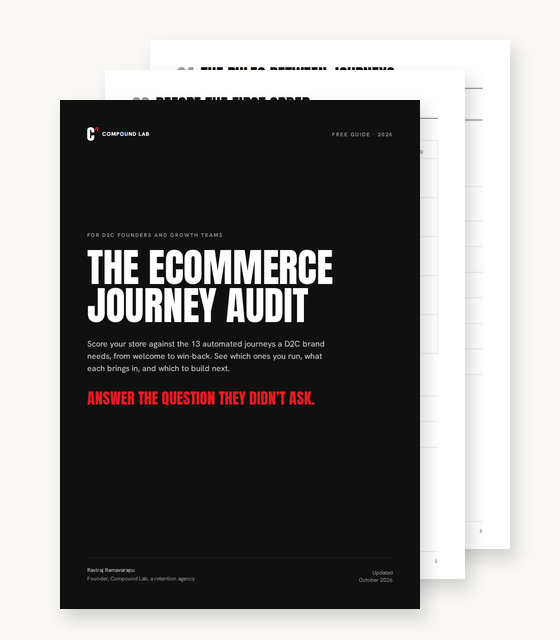
Free audit
Answer the question they didn’t ask.
The ecommerce journey audit. Score your store against the 13 journeys a D2C brand needs, and pick which to build next, in one PDF.
- A scorecard for all 13 journeys, from welcome to price drop
- The rules that stop journeys from clashing, as a checklist
- Channel costs at Meta’s India rates, and a build-next planner
Sent. Check your inbox.
The audit is on its way to .