
Replenishment and Cross-Sell Emails: When to Send Them
How to time replenishment reminders to when a product runs out, pick the right cross-sell from order data, and when an upsell should replace both.
Updated October 2026.
A replenishment email reminds a customer to reorder a product just before it runs out. A cross-sell email offers the product that naturally goes with what they already bought. Both are automated journeys that start after the first order, and between them they decide most second orders for a D2C brand.
Which one you lead with depends on what you sell. Consumables, like supplements, coffee, skincare and pet food, run out on a schedule, so replenishment comes first. Durables, like cookware, jewellery and apparel, don't run out, so the second order has to come from a cross-sell.
I run Compound Lab, a retention agency, and both journeys below come from my own work: replenishment at Healthify Store, cross-sell at Cumin Co, Zymrat and MyGate. They're two of the 13 journeys in my guide to ecommerce automation flows.
Replenishment: "Am I about to run out?"
Time it to the run-out date, minus delivery
At Healthify Store, a tub of whey protein lasted about 30 days. The refill reminder went out on WhatsApp on day 25. Delivery took three to four days, so a customer who ordered on day 25 or 26 got the new tub before the old one ran out.
That's the whole logic. Work out when this customer's product runs out, then subtract the time it takes to reach them.
Run-out date = delivery date + (quantity × days each unit lasts)
Reminder date = run-out date − delivery time − a day or two to decide
Use the delivery date, not the order date, and multiply by quantity. Someone who bought two tubs doesn't need a reminder on day 25.
What the reminder says
The first reminder is service, not a sale: you're about to run out, here's one tap to reorder the same thing. If they don't reorder, a second message on the run-out day, by email. If they still don't, I'd send one more about a week later, and that's the only place an incentive might go, for a first-time buyer who hasn't used one yet.
When they're tired of it, offer a variant
Some customers stop reordering because they're bored of the product, not the brand. At Healthify Store, if the refill reminder didn't bring a whey customer back, the next message offered a different flavour. Customers who had bought several flavours, each more than once, liked trying new ones, so the message pitched a new flavour and asked about the others.
Upsell instead, for repeat buyers
Someone who has bought the same product two or three times doesn't need a reminder of what it is. The better message is a better way to buy it: a bigger pack, a bundle, or a subscription at a standing price. I run that upsell in place of the replenishment reminder for repeat buyers, not on top of it, so they get one message about the reorder, not two.
If customers reorder on a fixed rhythm, a subscription removes the need to remember. In India, UPI Autopay lets a customer approve recurring payments once.
Cross-sell: "What goes with it?"
Read the next product from your order data
Don't guess the cross-sell, and don't send the bestseller list. Find the sequences your customers already follow.
At Cumin Co, I used to say that when I see the brand, I imagine empty kitchen racks, and I want to fill all of them. A kitchen needs a tawa, a kadhai, a Dutch oven, bowls and knives. We built a table of who bought what, in which order, and looked for the sequences that kept repeating. Dosa tawa buyers most often bought a Dutch oven next. Kadhai buyers were more likely to buy a knife set. So that's what we pitched to each of them.
At Zymrat, an activewear brand, a customer who bought a workout t-shirt was shown joggers or shorts, picked by which combination and colour went with the tee.
At MyGate, the same idea worked in an app. Residents who booked a cab to the airport were offered the ride home, and return pickups went from 21% to 30%.
To build the table yourself: export orders, sort each customer's orders by date, and count which category follows which. The pairs that keep repeating are your cross-sells.
Move one-time buyers to something they can reorder
Some products are bought once. Healthify Store sold hardware alongside supplements, and a hardware buyer had no reason to come back for another device. So we moved those buyers towards something repeatable, like whey protein. Supplements grew from 37% to 45% of the store's revenue.
When to send it
Wait until the first order has arrived and settled, after the post-purchase journey has done its job. A cross-sell in the order confirmation feels like a sales list. Then:
- Teach first. One message on how the two products work together. Why a Dutch oven after a tawa, what joggers do for a tee.
- Show the options. Two or three next products, not ten. On WhatsApp, a carousel works well here because people can choose.
- Then the set, with an incentive only if this is a first-time customer who hasn't had one.
Rules for both journeys
| Rule | Replenishment | Cross-sell |
|---|---|---|
| Who enters | First-time buyers of a consumable | Customers whose first order has settled, with nothing bought from the next category |
| Starts | A few days before their run-out date | After the post-purchase journey ends |
| Replaced by | Upsell, for repeat buyers of the same product | Nothing |
| Exits | A reorder of that product | An order from another category |
| Skip | Customers with an open return or complaint | Heavy returners and discount-only buyers |
| One incentive | Shared across both: one before the second order, recorded on the profile |
Margin before message. A cross-sell that only works with 30% off can lose money on the order it wins. Check what the order leaves after product, shipping and the offer. My CM1, CM2 and CM3 guide shows how.
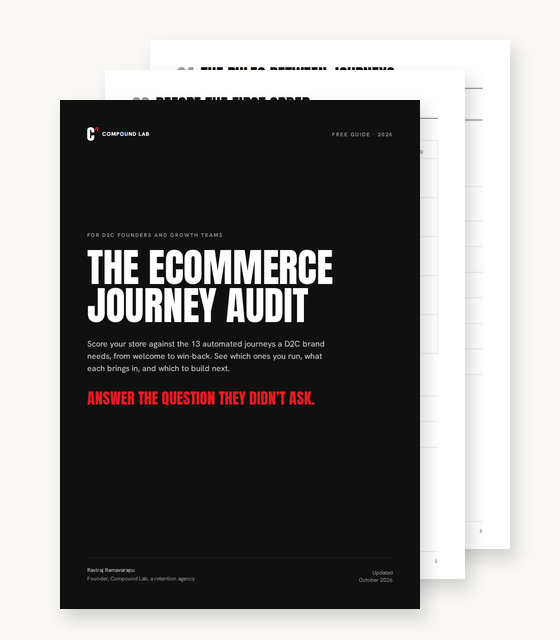
Free auditScore your store against all 13 journeys and pick which to build next, in one fillable PDF. Get the free audit
How to measure them
For replenishment, count reorders of the same product within about two weeks of the first reminder, against a holdout who got nothing. For cross-sell, count orders from the new category in the same window.
Then look at the order after. The real test of a cross-sell is whether the customer comes back a third time.
What other guides get wrong
| What many guides say | What's closer to true |
|---|---|
| Send replenishment emails 30 days after purchase. | Use the delivery date, the quantity and the delivery time. A fixed 30 days is late for some and early for others. |
| Cross-sell your bestsellers. | Cross-sell the next product your customers actually buy, read from order data. |
| Add a cross-sell to the order confirmation. | Wait until the product has arrived and been used. |
| Discount every reorder. | The first reminder is a service. Keep incentives for first-time buyers who haven't had one. |
| Run upsell, replenishment and cross-sell together. | One journey at a time. Upsell replaces the reminder for repeat buyers. |
Where I fit
Most brands I talk to send the same "you might also like" email to everyone, 30 days after every order. Compound Lab is a retention agency, and reading the next product from your order data, then timing it to each customer, is the work. Book a 30-minute call and we'll look at where your second order should come from.
FAQ
What is a replenishment email? An automated reminder sent just before a customer's product runs out, with an easy way to reorder. It's timed from the delivery date, the quantity bought and how long each unit lasts.
When should I send a replenishment reminder? A few days before the product runs out, allowing for delivery time. If a product lasts 30 days and delivery takes three to four, send it around day 25.
What is a cross-sell email? An email offering a product that goes with something the customer already bought, like a knife set after a kadhai. The best cross-sells come from the order sequences your customers already follow.
What is the difference between cross-selling and upselling? Cross-selling offers a different, related product. Upselling offers a better or bigger version of what they're buying, like a larger pack or a subscription.
How do I find the right product to cross-sell? Export your orders, sort each customer's orders by date, and count which category most often follows which. The pairs that repeat are your cross-sells.
Should replenishment reminders include a discount? Not the first one. A reminder before someone runs out is a service. Keep any incentive for a later message, and only for a first-time buyer who hasn't had one.
Can I send replenishment reminders on WhatsApp? Yes, with the customer's opt-in. It's a marketing message, so it costs ₹0.8631 per delivered message in India, before GST, as of October 2026. Its timing makes it one of the better uses of that cost.
Free audit
Answer the question they didn’t ask.
The ecommerce journey audit. Score your store against the 13 journeys a D2C brand needs, and pick which to build next, in one PDF.
- A scorecard for all 13 journeys, from welcome to price drop
- The rules that stop journeys from clashing, as a checklist
- Channel costs at Meta’s India rates, and a build-next planner
Sent. Check your inbox.
The audit is on its way to .