
How to Become a CRM Marketer in India: A Career Guide From the Inside
How to become a CRM or retention marketer in India with no experience: the metrics to learn, the D2C funnel, practice projects, first job titles and salary ranges.
Updated October 2026.
A CRM marketer, also called a retention or lifecycle marketer, runs a brand's CRM marketing. They decide what the brand says to customers it already has, when, and on which channel: email, WhatsApp, SMS, push or in-app. The job is to get a first-time buyer to order again, and a new app user to keep coming back.
You don't need a marketing degree to get into it. You need three things before your first interview: the metrics, the funnel as an operator sees it, and one or two practice projects that show you can read data. This guide covers all three, plus the skills behind them, the job titles to search for, what the work pays, where the career leads, and whether AI will take it.
I studied English literature and never planned a career in marketing. I've spent about seven years in CRM since, from writing copy to heading CRM and ecommerce, and now I run Compound Lab, a retention agency.
CRM marketing vs CRM sales
Search for CRM jobs in India and half of what comes back is sales work: calling leads for a real estate project, following up on bank loans, updating records in Salesforce. Those roles use a CRM tool. They aren't CRM marketing.
| Item | CRM marketing | CRM sales |
|---|---|---|
| Who you talk to | Thousands of customers at once, through automated messages | One lead at a time, usually by phone |
| What you're judged on | Repeat orders, retention, revenue from existing customers | Leads called, deals closed |
| Tools | CleverTap, MoEngage, WebEngage, Klaviyo, Omnisend | Salesforce, Zoho, HubSpot sales |
| Where the jobs are | D2C brands, consumer apps, agencies | Real estate, banking, B2B sales teams |
I've written a fuller comparison of CRM marketing vs CRM sales, including MQL and SQL. This guide is about CRM marketing. When you search for jobs, add words like "retention", "lifecycle", "email marketing" or "D2C" to filter out the sales roles.
The skills a CRM marketer needs
The job sits between writing and numbers. You don't need to be great at all of these on day one, but you should know they're coming.
| Skill | What it looks like in the job |
|---|---|
| Writing | Subject lines, WhatsApp messages and push copy that sound like the brand and make one clear ask |
| Data | Reading campaign reports, spotting what changed, working in Excel or Google Sheets (filters, pivots, lookups) |
| Customer thinking | Knowing what a customer expects at each point after they buy, and what would annoy them |
| Segmentation | Splitting customers into groups by what they did: first-time buyers, repeat buyers, lapsed, high spenders |
| Journey logic | Turning "if this, then that, after this long" into automations on a CRM platform |
| Testing | Sending two versions to small groups, checking which won, and knowing when a result means something |
| Channel rules | Consent, opt-outs and the rules for each channel, so the brand stays allowed to message people |
SQL helps and will matter more as you grow, but most first CRM roles test Excel or Sheets, not SQL.
Step 1: Learn the metrics
Every campaign you send will be judged on a handful of numbers. Know what each one means and what it's measured against, because interviewers ask.
| Metric | What it measures |
|---|---|
| Delivery rate | Emails that reached an inbox, out of emails sent |
| Open rate | People who opened, out of emails delivered |
| Click rate | People who clicked a link, out of emails delivered |
| Click-to-open rate | People who clicked, out of people who opened. It tells you if the email itself worked |
| Conversion rate | People who bought or did the action you wanted |
| Unsubscribe rate | People who opted out after the email |
Open rates are less reliable than they used to be, because Apple Mail opens emails automatically for privacy. Clicks and conversions tell you more.
| Metric | What it measures |
|---|---|
| Delivery rate | Messages delivered, out of messages sent |
| Read rate | Messages read (the blue ticks), out of messages delivered |
| Click rate | People who tapped a button or link |
| Conversion rate | People who bought or did the action |
| Block or opt-out rate | People who blocked you or asked you to stop |
WhatsApp read rates are much higher than email open rates, and that's why brands use it. It's also why WhatsApp limits how many marketing messages a person gets. I've written about that limit in WhatsApp error 131049.
SMS and push follow the same pattern: delivery, click or open rate, and conversion. Push also has opt-in rate, because people can switch notifications off.
The business metrics. Channel numbers tell you whether a message worked. These tell you whether retention is working at all, and they're what your manager reports upwards.
| Metric | What it measures |
|---|---|
| Repeat purchase rate | Customers who ordered more than once, out of all customers |
| Time between orders | The usual gap between a first and second order. It tells you when to message |
| Customer lifetime value (LTV) | Total revenue from a customer over their time with the brand |
| Churn | Customers or subscribers who stopped buying or cancelled |
| Cohort retention | Of the customers who joined in one month, how many are still active one, two and three months later |
| D1, D7, D30 retention | For apps: users who came back one, seven and 30 days after installing |
Tools and teams don't always name these the same way. Some call click rate "CTR", some use CTR for click-to-open. When in doubt, ask what it's divided by.
Step 2: Learn the funnel as an operator
You've been a customer on D2C websites hundreds of times. Now walk through one as the person running it, and notice where the brand is nudging you.
Say you land on a skincare brand's website for the first time.
- You arrive and browse. A pop-up offers 10% off your first order if you share your email or phone number.
- You sign up. You get an email or WhatsApp with the code. You feel like you've unlocked something.
- You view a collection, then a product. If you leave now, the brand knows which product you looked at.
- You add to cart. If you don't check out, you'll get an abandoned cart message, often within an hour.
- You check out and pay. An order confirmation arrives, then shipping and delivery updates.
- You get a cross-sell. Something that goes with what you bought, timed for when you've used the first product.
- You get loyalty coins. Points or credits that only work on your next order.

Every one of those messages was set up by a CRM marketer. Each one has a trigger (what the customer did), a condition (who gets it and who doesn't), a channel, a wait time and a goal. Once you can see a funnel this way, you can sit in an interview and say what's missing from a brand's journey. Very few freshers can.
Apps work the same way with different moments: install, sign-up, the first time a user does the core action (books a ride, logs a meal, places an order), then the habit. The CRM job in an app is mostly about getting users to that first core action and then keeping them coming back.
Notice the rules too. A brand can only message you on WhatsApp because you opted in, and every marketing email has an unsubscribe link. SMS in India goes through DLT registration with telecom operators, and India's Digital Personal Data Protection Act brings stricter consent rules for how brands collect and use customer data. You don't need to be a lawyer, but a CRM marketer who knows these rules is trusted with more.
Do this for five brands you buy from. Sign up, add to cart, leave, and screenshot every message you get for two weeks. That folder is the start of your portfolio.
Free starter kitThe metrics, funnel map, practice projects and job tracker from this guide, as one fillable PDF. Get the free starter kit
Step 3: Build practice projects
This is what gets you hired with zero experience. A CRM executive spends most of the day doing two things: reading campaign data, and building journeys. Show both.
For a week-by-week plan to learn the tools and build these projects for free, follow my six-week roadmap to learn CRM tools.
A data project. Take a mock dataset of customers and orders (you can generate one, or use a public ecommerce dataset). Slice it. Who bought once and never came back? How long is the usual gap between first and second order? Which campaigns drove the most repeat orders? Write up three findings and what you'd send because of each.
A journey project. Pick one of the brands from Step 2 and map a journey you'd add. Write out the trigger, the conditions, the wait times, the channels and the messages. For example: customers who bought a face wash 25 days ago and haven't reordered get a WhatsApp reminder, and if they don't read it in two days, an email.
A live project, if you want to go further. Klaviyo's free plan allows up to 250 contacts and 500 email sends a month, enough to build a welcome flow and an abandoned cart flow on a test store and send them to yourself and friends. Screenshots of a working flow beat any certificate.
Bring both to the interview. Being able to explain why a campaign behaved the way it did, and what automation you'd build with which conditions, is most of what the first interview tests.
Step 4: Get the first job
Job titles to search for: CRM executive, CRM associate, retention marketing executive, lifecycle marketing associate, email marketing executive. Add "D2C" or "app" to the search.
Who hires juniors: D2C brands, consumer apps and agencies all do. A brand with a head of growth and a CRM manager usually needs an executive to run the campaigns, and that execution can be taught in a month to 45 days.
Where I'd start: an agency. At a brand you work on one business. At an agency you work on several at once: a fashion brand, a supplement brand, an app. In a year you'll have seen more kinds of customers, data and problems than most people see in three. Then move to a brand and go deep on one business.
What to put on your CV and what interviews ask
Put your projects at the top of your CV, above your education. Link to a one-page write-up or a short deck for each: the question, what you found in the data, and what you'd send. Do the same on LinkedIn.
First CRM interviews usually test the same few things:
- Metrics. What is click-to-open rate, and why would it drop while open rate stays the same?
- A brand's journey. Pick a brand you shop from. What messages did you get after your first order, and what's missing?
- A data case. Repeat orders fell 15% this month. Where do you look first?
- A journey you'd build. Customers who bought once and never came back: what would you send them, when, and on which channel?
- Writing. Write a WhatsApp message for an abandoned cart, in two lines.
If you've done Steps 1 to 3, you've already answered most of these. For the full list by level, with case questions and what strong and weak answers sound like, see my guide to CRM interview questions.
What CRM marketers earn in India
Salary sites aren't much help here, because they mix CRM marketing with CRM sales and real estate roles. These ranges come from my own path, from a copywriter and email marketer to heading CRM, and from people I've hired and worked with. They vary by city, company and how much the business depends on retention.
| Stage | Typical roles | Rough range |
|---|---|---|
| Starting out | Copywriter, email marketer, CRM executive | ₹4 to 10 LPA |
| Two to four years | Senior CRM executive, CRM associate at an app | ₹12 to 18 LPA |
| Manager | CRM manager, retention manager | ₹20 to 30 LPA |
| Lead | Head of CRM, head of retention, D2C business head | ₹30 LPA and up |
When I started, there were few people who could do this well, so the ones who could were paid for it. As more brands realise that acquisition alone doesn't pay back, demand for people who can keep customers is growing, and so are the opportunities for people with real skills.
Where the career leads
A CRM executive usually becomes a CRM or retention manager within a few years, then a head of CRM or retention. From there the paths widen. Because the job joins customers, data and revenue, CRM people move into product marketing, growth and business roles. My own path went from copy to CRM to product marketing to running a D2C business and its CRM.
Will AI replace CRM marketers?
No. AI makes a CRM marketer stronger.
On copy: I used to write every message by hand. Now AI helps you see what you want to say to an audience faster and try more versions of it. The judgement about what to say, and to whom, is still yours.
On data: if you give AI a dataset and ask for insights, you get generic answers. If you tell it what you want to look at, what your instinct says is happening, and which calculations would prove it, it does in minutes what used to take a day. The instinct is the job. AI checks it.
On tools: CRM platforms are adding AI features every quarter. Make AI part of how you work from day one, and you'll be faster than people with more years than you.
FAQ
Is CRM marketing a good career in India? Yes, if you like both writing and numbers. Every D2C brand and consumer app needs repeat customers, and few people can both read the data and write the message. That combination is what gets paid.
Can I become a CRM marketer with no experience? Yes. Learn the email and WhatsApp metrics, study how D2C funnels nudge customers, and build one data project and one journey project. Those show an interviewer you can do the work before anyone has paid you to.
What is the difference between CRM marketing and CRM sales? CRM marketing sends automated messages to existing customers to bring them back, and is judged on repeat revenue. CRM sales uses a CRM tool to follow up on leads one at a time, and is judged on deals closed.
What does a CRM executive do? Sets up and sends campaigns on email, WhatsApp, SMS and push, builds automated journeys, and reports on how they performed. Most of the day is split between the CRM platform and the campaign data.
What is the salary of a CRM executive in India? Roughly ₹4 to 10 LPA at the start for marketing roles, rising to ₹20 LPA and above at manager level. Figures on salary sites often mix in CRM sales roles, which pay differently.
Will AI replace CRM marketers? No. AI speeds up copywriting and data analysis, but someone still has to decide what the data means and what each customer should hear. People who use AI well will replace people who don't.
Do I need to know SQL for a CRM job? Not for most first roles. Excel or Google Sheets is what gets tested. SQL becomes useful as you move up and want to pull your own data.
Should I join an agency or a brand first? An agency, if you can. You'll work across several brands at once and learn faster. Move to a brand later to go deep on one business.
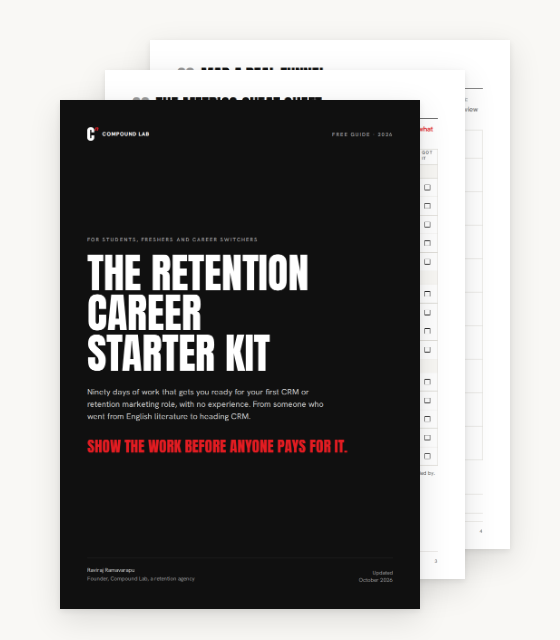
Free starter kit
Show the work before anyone pays for it.
The retention career starter kit. Ninety days of work that gets you ready for your first CRM or retention marketing role, in one PDF.
- A 90-day plan and a metrics cheat sheet for email, WhatsApp and the business
- A funnel map, a journey builder and a data project to show in interviews
- Interview questions to practise and a job tracker
Sent. Check your inbox.
The starter kit is on its way to .