
Anonymous Website Visitors: Turn Them Into First Orders
Most D2C website visitors leave without buying and without a name. How to identify them, what to send in the first hours, and how to measure the first order.
Updated October 2026.
Getting anonymous website visitors to a first order starts with knowing who they are. Name the visitor with a pop-up that offers something other than a discount, or a one-tap sign-in at login or checkout. Then wait 30 minutes, and if there's no order, start a pre-purchase journey. A founder welcome sent once, a different message for each place they dropped off, and a measured funnel from visitor to first order.
I'm Raviraj Ramavarapu, founder of Compound Lab, a retention agency for D2C brands and consumer apps. Retention gets the attention, but most of the people a D2C brand pays to bring in never buy and never leave a name. This is the pre-purchase half of the plans I build, the part that decides how many first orders the retention work gets to keep.
Why can't you message most of your website visitors?
Because you don't know who they are, and even when you do, you need their permission. A visitor who arrives from an ad, browses and leaves is anonymous. You can retarget them with ads, but you can't send them an email or a WhatsApp message.
Two rules decide who you can actually reach:
- WhatsApp needs an opt-in. Meta's policy requires a person's phone number and their opt-in, with the business named clearly, before a business can message them.
- India's data protection rules raise the bar. Under the Digital Personal Data Protection Rules, notified in November 2025, brands must meet the notice and consent requirements by 12 May 2027. Collect consent per channel now, and record when and where each person gave it.
So the first number to fix isn't conversion rate. It's the share of visitors you can name and legally reach.
How do you identify anonymous website visitors?
Give them a reason to tell you who they are, at the moment it helps them. There are two main ways, and most brands should run both.
- A pop-up with a reason that isn't a discount. An exit-intent pop-up offering a first look at new arrivals, early access to the next launch, or help choosing a size. Test it against a small prepaid code and judge it on first orders, not sign-ups. A code gets more sign-ups and often teaches people to wait.
- One-tap sign-in at login or checkout. Several Indian checkout providers offer identity tools that recognise a returning shopper's phone number in one tap. Every recognised shopper can enter a journey.
Past customers and logged-in shoppers are already known. Make sure your CRM treats them as one profile across website, app and WhatsApp, not three. I cover the pop-up itself in welcome series and pop-ups.
What should happen after a visitor is identified?
Give them 30 minutes. If they haven't ordered by then, they enter a journey based on what they did.
| What they did | First message | If they come back and still don't buy | If they still don't buy |
|---|---|---|---|
| Left the site, not identified | Exit-intent pop-up: a first look at new arrivals | Don't show the same pop-up again for 7 days | Ads to the same audience, led by founder content |
| Browsed a collection | The founder welcome, by email and WhatsApp | The product they viewed, with its story | Nurture |
| Viewed a product | The founder welcome if they haven't had it, else that product's story | Real customers using it | Nurture |
| Added to cart | The cart journey: their cart, fit help, delivery and returns | Two-way size help on WhatsApp | Nurture, with any offer last |
| Started checkout | One tap back to checkout, with cash on delivery and prepaid made clear | A small prepaid incentive, here and only here | Nurture |

Nurture means people who've heard from you and still haven't bought: new arrivals, season edits and founder stories, at most two messages a week. The moment they browse again, they move back into the journey. The browse and cart steps are covered in detail in browse abandonment and WhatsApp cart recovery.
What is a founder welcome, and why send it only once?
It's the first message a new visitor gets from your brand, and it's about why the brand exists, not what's on sale. Send it once in a person's lifetime, so it stays special.
- By email: the founder's story of why the brand exists, with pictures from the collection they browsed and a button back to it.
- On WhatsApp, if they opted in: a short founder video about that collection, with the same button.
- The rest of the range: shown once, lightly, so they know what else you make.
If they come back, they don't get the welcome again. The second visit gets the product they looked at and what makes it worth the price. A third visit gets real customers using it. Each message answers the next question a stranger has: who are you, why this product, and does it work for people like me.

What builds trust before the first order?
Reasons to trust, not reasons to return. A stranger hasn't used your product yet, so the messages have different jobs from retention ones. Use one angle per message.
| Angle | What it answers |
|---|---|
| The founder | Who's behind this, and why does it exist? |
| Craft and material | What makes it worth the price? |
| Social proof | How many people like me already bought it? |
| Real customers | What does it look like on someone like me? |
| Being noticed | What will people say when I wear or use it? |
| Moments | Where will I use it: work, weddings, travel, gifting? |
| Ease | Will it fit, when will it arrive, and can I return it? |
Pick one customer number and use it everywhere. When the website says one figure and the ads say another, careful buyers notice, and trust drops at exactly the wrong moment.
How do you measure the pre-purchase funnel?
Track one number per stage, from unknown visitor to first order, every two weeks, against a holdout.
| Stage | The number | What it tells you |
|---|---|---|
| Unknown visitors | Unique visitors a week | The size of the pool |
| Identified | Share of visitors you can name, by pop-up and by one-tap sign-in | Whether identity capture works |
| Reachable | Share of identified people with at least one opted-in channel | Whether you can talk to them at all |
| Messaged | Share of reachable people who got a message in the last 30 days | Whether the journeys are firing |
| Engaged | Click or reply rate | Whether the messages are worth reading |
| First order | First orders from people in journeys, against a holdout | The lift you can actually claim |

The stage that's furthest off is where to start. If only a small share of visitors is identified, no message will fix it. If many are identified but few are reachable, the opt-in is the problem. Read each message on orders, not opens, as I explain in email subject line testing. After the first order, the retention side takes over, which starts with retention metrics.
Where I fit
Compound Lab works with D2C brands and consumer apps on everything around the first order, from naming the visitor and the founder welcome in our cart recovery program to the second order and beyond. If your ads bring traffic and your first orders don't follow, book a 30-minute call and we'll find the stage where your visitors drop out.
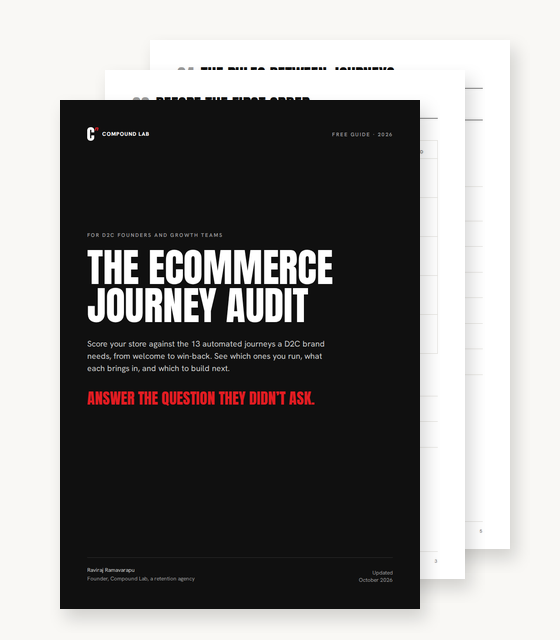
Free audit
Answer the question they didn’t ask.
The ecommerce journey audit. Score your store against the 13 journeys a D2C brand needs, and pick which to build next, in one PDF.
- A scorecard for all 13 journeys, from welcome to price drop
- The rules that stop journeys from clashing, as a checklist
- Channel costs at Meta’s India rates, and a build-next planner
Sent. Check your inbox.
The audit is on its way to .