
 D2C / 01
77%CRM revenue from automations
Repeat purchase program for D2C brands in India
Compound Lab builds and runs the system that brings first-time buyers back: a target day for the second order, a journey for every first purchase, and reasons to return that aren’t a discount. Measured on repeat rate, not open rates.
Run by Raviraj Ramavarapu, who works every account himself.
A repeat purchase program is a set of journeys that move a customer from the first order to the second, third and beyond, built around the gap between orders. It decides what each buyer sees next, on which channel and when, and it is measured on repeat rate and days to the second order.
Sound familiar?
Ads bring in first orders every month, but repeat rate hasn’t moved in a year.
The only thing that brings buyers back is a discount, and margin pays for it.
After the order, the customer hears two things: a confirmation and a review request.
Nobody on the team can say how many days it takes a buyer to come back.
That isn’t a channel problem. It’s a missing system between the first order and the second.
What changes
A repeat purchase program turns the time after the first order into a plan with a deadline.
A campaign calendar, the same for everyone
A journey for every first purchase
A discount to bring people back
A reason to return: a restock, a new drop, the next size
Repeat rate read once a month
Repeat rate read every week, by cohort
The second order happens when it happens
A target day for the second order, and a journey built to beat it
How it works
We find the usual gap between first and second order in your data, then pull it forward. Every step has one job, and it is triggered by what the buyer did.
How we build it
The same process we run for every brand, pointed at the gap between the first order and the second.
Read every first-purchase cohort and find the usual gap to the second order.
Track what happens after the order: delivery, first use, reviews, browsing.
Group buyers by what they bought first and where they are in the gap.
Build the first 28 days for each cohort, with a target day for order two.
Every step runs on its own, triggered by what the buyer does.
Test timing, message and the reason to return. Keep what moves repeat rate.
Order two feeds order three. Each cycle builds on the last.
Three D2C brands, the system we built for each, and what it returned.
All case studiesD2C / 01 D2C / 05
 D2C / 03
The first 90 days
One plan, run in the open. Every phase has one output, and you see all five numbers every month.
Audit and diagnoseWeeks 1 to 2
Repair and planWeek 3
Launch togetherWeeks 4 to 6
Run and readWeeks 7 to 10
Optimise and expandWeeks 11 to 13
The monthly report
The five numbers you see every month. Illustrative direction, not your data.

Why Compound Lab
Raviraj built these systems in-house at Healthify Store and Cumin Co, and works every account himself. No handoff to a junior team after the pitch.
Strategy, copy, setup and testing come from one team, so nothing dies between the deck and your CRM.
Repeat rate and revenue per buyer, read every week, on the platform you already use.
Platforms
Platform-agnostic. We fit your stack, not the other way round. These are the ones we’ve run with revenue on the line.
 CleverTap
 MoEngage
 WebEngage
 Kwik Engage
 LimeChat
 Zoko
 Shopify
 Nitro
 Exotel
Questions
It depends on category and price. We read yours by cohort in week one and benchmark it against your own past, which tells you more than an industry average. Our benchmarks guide has the ranges.
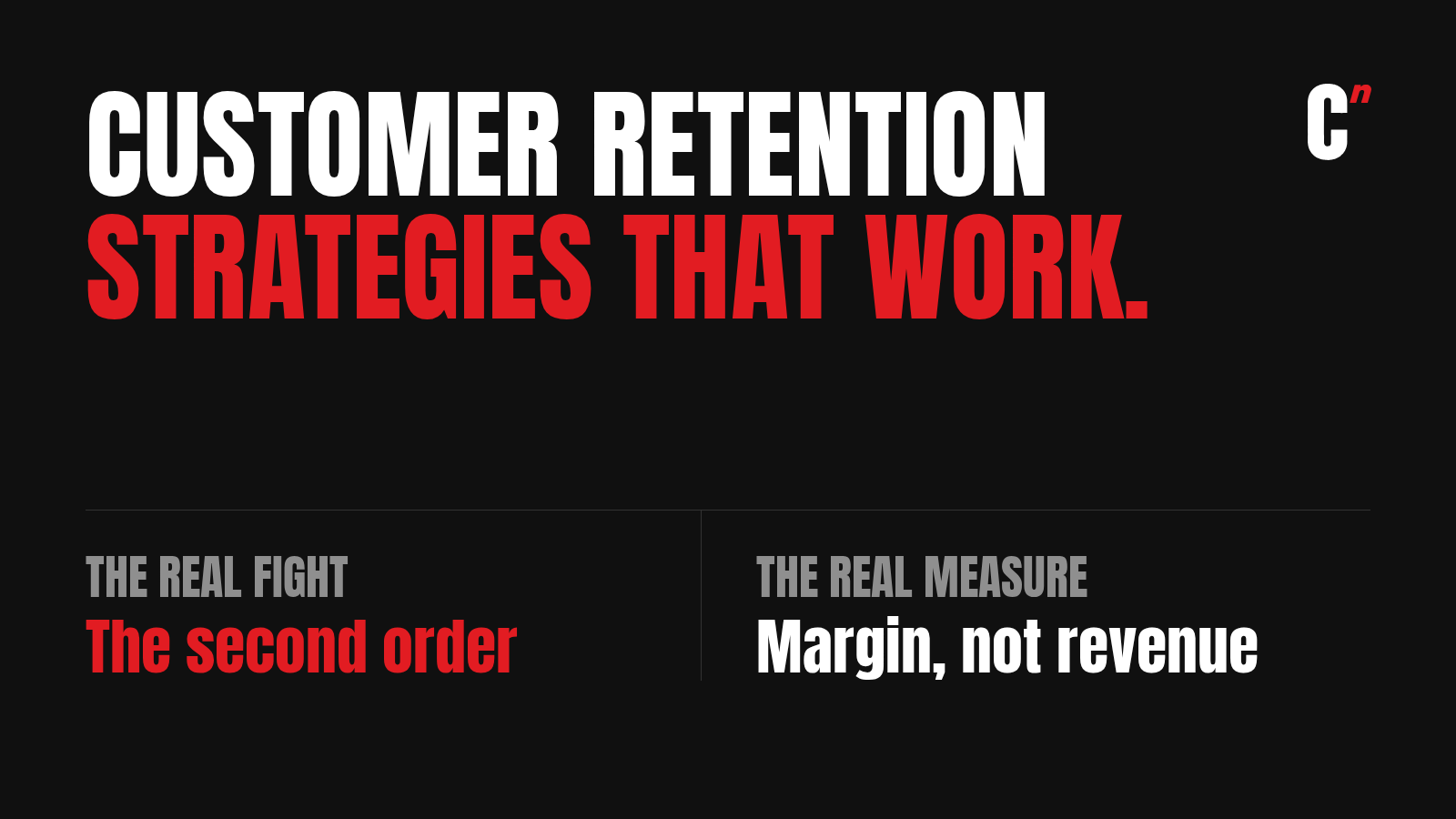
Give customers a reason that isn’t price: a restock, a new drop, a size alert, a season, a story. Codes come last and go to the cohorts that need them. More in repeat purchases without discounts.
Before the usual gap between first and second order in your data, not after it. That day is different for every brand and category.
WhatsApp, email and SMS, plus push for brands with an app. Each has one job, on the platform you already use.
Yes. Every message, in your brand’s voice. It’s part of the service.
No. It works for D2C brands with steady first orders and a range worth coming back to. For products people buy once every few years, like a mattress, retention is the wrong lever, and you’ll hear that on the call.
Find the usual gap between the first and second order in your own data, set a target day before it, and run a journey for each first-purchase cohort that gives buyers a reason to return that isn’t a discount. Read repeat rate by cohort every week so a dip is caught early.
Five numbers: repeat purchase rate, days from first to second order, orders per buyer, revenue per buyer, and the share of repeat orders that needed a code.
After the audit, scoped to your stack and the stages you want us to run. We share it on the call once we know what needs building.
Benchmarks, examples and the maths behind the second order.
Need more than one stage? We run the whole lifecycle as one engagement.
See the full lifecycleBook a call
Thirty minutes with Raviraj, not a sales team. On the call we look at three things: