
Customer Retention Strategies: 15 Real Examples
15 customer retention strategies with real examples from Indian D2C brands and apps: cross-sell, refills, usage, COD, loyalty, referral and win-back.
Updated October 2026.
Customer retention is how many of your customers keep buying from you over time. Customer retention strategies are the planned moves that make the next order happen: what you send each customer, on which channel, at what moment, and with what offer.
Most guides on this topic are written for software companies, in dollars. This one is for D2C brands and consumer apps in India. Almost every strategy below comes with a real example from brands I've worked at or with: Zymrat, Healthify Store, the Healthify app, Cumin Co, MyGate and PNG Jewellers. I run Compound Lab, a retention agency, and these are the moves I'd make again.
What is customer retention?
Customer retention means keeping the customers you already paid to acquire, so they buy again instead of drifting away or switching to someone else. The opposite is churn.
The standard customer retention rate formula is:
Retention rate = ((customers at the end of a period − new customers in that period) ÷ customers at the start) × 100
Say you start a quarter with 1,000 customers, end it with 1,050, and 300 of those are new. Your retention rate is ((1,050 − 300) ÷ 1,000) × 100 = 75%.
That formula comes from subscription businesses, where "a customer" is someone currently paying. A D2C store has no such line, so most brands track repeat purchase rate instead: the share of customers who bought more than once in a period. Work yours out with the repeat purchase rate calculator.
Measure retention in margin, not revenue
Almost every guide calculates customer lifetime value as revenue: average order value × orders × years. That number flatters you, because discounts, shipping and payment fees all come out of each order before you keep anything.
Here is the same customer measured both ways. The numbers are an example, not from any brand.
| Item | Revenue view | Margin view |
|---|---|---|
| Average order value | ₹1,200 | ₹1,200 |
| What you keep per order, after product, shipping, payment fees and discount | ₹1,200 | ₹420 (35%) |
| Orders over two years | 4 | 4 |
| Lifetime value | ₹4,800 | ₹1,680 |
| Acquisition cost | ₹900 | ₹900 |
| Order that pays back acquisition | The first | The third |
In the margin view, the first two orders don't earn back what you spent to win the customer. The third does. That's why retention decides whether a D2C brand makes money at all, and why the customer lifetime value calculator asks for your margin and acquisition cost.
Where retention breaks: the second order
The hardest order to win is the second one. A first-time buyer took a chance on you. A second order means they've decided you're worth coming back to, and the orders after that get easier.
At Cumin Co, a premium cast iron cookware brand, getting the second order was the main goal. A cast iron pan lasts close to ten years, so nobody needs to replace it. The second order had to be a different product.
Before choosing tactics, find where your customers stop. Group customers by the month of their first order, and track what share of each group bought again in month one, two, three and so on. That table is a cohort view. If most of the drop happens before the second order, fix the second order first. Read how to read your repeat purchase rate for what a good number looks like in your category.

15 customer retention strategies that work
The strategies follow a customer's life with your brand, from before the first order to winning them back. Each one has what I did, where, and what it changed.
1. Capture visitors before the first order
Retention starts before the first purchase. Most visitors leave without buying, and if you haven't captured a phone number or email, you can't talk to them again without paying for another ad.
At PNG Jewellers, we built six journeys from scratch: capture, browse, product, cart, checkout and cross-sell. Those automated journeys brought in 77% of the brand's CRM revenue. Read the PNG Jewellers case study, and for the cart step, my abandoned cart WhatsApp flow.
2. Protect the first delivery: COD, prepaid and RTO
In India, the first order can fail before it arrives. Cash on delivery (COD) orders get refused or come back as RTO (return to origin), and a customer who never received the first order won't place a second.
When Zymrat, an activewear brand I worked with, switched COD on, a lot of orders came back. People ordered for the sake of it and weren't at the address to accept the parcel. The losses were heavy enough that the brand switched COD off.
You don't have to go that far. Two levers move buyers from COD to prepaid:
- A prepaid incentive. A small discount, often around 5%, for paying online. Checkouts like GoKwik's Kwik Checkout let you set discounts by payment method.
- Partial COD. The buyer pays a token amount or a percentage upfront and the rest on delivery. Someone who has already paid something is less likely to refuse the parcel.
Then send delivery updates on WhatsApp. Order and shipping updates are utility messages, which cost a fraction of a marketing message. My WhatsApp API pricing guide has the current rates.
3. Cross-sell the product they're most likely to buy next
The second order is easiest to win with the right next product, picked from what customers actually bought.
- Zymrat. A customer who bought a workout t-shirt was shown joggers or shorts, picked by which combination and colour went with the tee.
- Cumin Co. I used to say that when I see Cumin Co, I imagine empty kitchen racks, and I want to fill all of them with Cumin Co. A kitchen needs a tawa, a kadhai, a Dutch oven, bowls and knives. We built a table of who bought what, in which order, and looked for the sequences that kept repeating. Dosa tawa buyers most often bought a Dutch oven next. Kadhai buyers were more likely to buy a knife set. So that's what we pitched to each of them.
- MyGate. In the app, residents who booked a cab to the airport were offered the ride home. Return pickups went from 21% to 30%. Read the MyGate case study.
The method is the same in each case. Don't guess the next product. Read it from your order data, and pitch it to the segment that's most likely to buy it.
4. Remind them before they run out
For anything that gets used up, time the reminder to the product, not to your campaign calendar.
At Healthify Store, a tub of whey protein lasts about 30 days. The refill reminder went out on WhatsApp on day 25. Delivery takes three to four days, so a customer who ordered on day 25 or 26 got the new tub before the old one ran out.
5. Offer a new variant before they get bored
Some customers stop reordering because they're tired of the product, not of the brand. At Healthify Store, if the refill reminder didn't bring a whey customer back, the next message offered a different flavour. Someone tired of chocolate may still want protein. A new variant keeps the customer with you instead of sending them to try another brand.
6. Move one-time buyers to a product they can reorder
Some products are bought once. Healthify Store sold hardware alongside supplements, and a hardware buyer had no reason to come back for another device. So we moved those buyers towards something repeatable, like whey protein.
Supplements, the category customers reorder, grew from 37% to 45% of the store's revenue. The full story is in the Healthify Store case study.
7. Get customers using what they bought
A product that isn't used never creates the need for the next one. A tub of whey that sits unopened won't be reordered. A subscription nobody uses won't be renewed, and the same goes for an app or a software plan someone has paid for. Usage comes before every repeat order and every renewal.
At Cumin Co, we led with service: care and seasoning guidance for the cookware each customer had bought. Useful messages earned clicks from people who had stopped engaging. Read the Cumin Co case study.
Watch usage and satisfaction together. In my experience, when people stop using a product, their Net Promoter Score (NPS) drops, and a low score makes the next renewal much harder to win. Ask for NPS once the customer has had time to use the product, and follow up with the ones who score low.
8. Make it easy for customers to reply
Messages that only talk at customers get ignored. At Cumin Co, customer replies used to go to a separate service number, so the marketing number looked like it only ever broadcast. We added quick-reply buttons to every message and an AI assistant with a human handoff, so conversations stayed on the number customers already knew. A number people talk to gets its messages delivered, and a customer whose question gets answered has one less reason to leave.
9. Reward the next order
A loyalty programme works when the reward pulls the customer back to spend it.
Healthify Store used Shopflo's checkout, which has a rewards feature: a brand sets a percentage of each order to come back as reward points, renames the points, and lets customers spend them at checkout. We called them Healthify coins. Every order earned coins worth 10% of its value. Messages reminded customers they had coins waiting, and at checkout the coins came off the price. Customers kept coming back to use them.
Two settings decide whether coins pay for themselves: an expiry, so the reward creates urgency, and a cap on how much of an order coins can cover. The maths section below shows why.
10. Turn customers into referrers
A customer who brings in a friend is telling you they plan to stay. At Healthify, both sides got something: the member who referred and the friend who joined each got one month of coaching free. Rewarding both gives the existing customer a reason to ask and the friend a reason to say yes. Pay the reward in your own product or service rather than cash, so it brings both of them back to use it.
11. Win back lapsed customers with their own data
A win-back message that could have gone to anyone usually gets treated that way.
At Healthify, lapsed premium users used to get one template with one offer. We built messages from each user's own progress instead: weight lost, workout days, meals logged, with fallbacks when data was missing. Same users, same channels. Click-through went up 2.1 times and revenue went up 79%. Read the win-back case study, and see WhatsApp win-back messages and win-back campaigns for how to build one.
12. Message less, at better moments
Sending more messages feels like more retention. On WhatsApp, it often does the opposite.
At Cumin Co, fewer than one in four WhatsApp messages were being delivered, and the rate was slipping every month. We capped marketing at two messages per customer a week, down from three or four, moved sends into journeys triggered by what customers did, and moved replies onto the marketing number. Delivery went from 23% to 44% in a month, and 1.9 times as many messages reached customers. More in why WhatsApp messages stop delivering.
13. For apps, build the habit before the paywall
Consumer apps lose users before they ever pay. Retention there means getting a new user to the first moment of value, then back again without being asked.
In the Healthify app, in-app surfaces carried a large share of revenue. The Plans page drove 27% of Healthify+ revenue, and the welcome shown to returning users drove 26%. Read the in-app funnels case study.
14. Offer a subscription where the product runs out on a schedule
If customers reorder the same thing every month, a subscription removes the need to remember. In India, UPI Autopay lets a customer approve recurring payments once instead of paying each month. Give subscribers a reason to stay, like a lower price or free shipping, and let them pause or skip instead of cancelling. Subscription retention is measured differently from repeat purchase, so don't compare the two numbers.
15. Keep prices fair instead of discounting deep
When whey prices jumped, Healthify Store's new stock was coming in at a higher cost. There were two options: raise prices sharply and keep the same discounts, or keep prices lower than other brands and cap discounting. We kept prices lower and capped the discounts. Conversions held up well, because the product was the hero, not the offer. Deep discounts teach customers to wait for the next sale. The maths below shows what they cost.
How to know which strategies are working
A control group isn't a retention strategy. It's how you check that the strategies above are working. Retention revenue is easy to overcount, because some of the customers who bought after your message would have bought anyway. A control group, a random slice of customers who don't get the messages, shows how much your programme actually added. My guide to the holdout group and global control group explains how to size one and read the lift.
The maths: when a retention offer loses money
Discounts are a margin decision, not a marketing one. Here's why, using the example customer from earlier, who leaves you ₹420 on a ₹1,200 order.
| Offer on the next order | Cost to you | What you keep from that order |
|---|---|---|
| No offer | ₹0 | ₹420 |
| 10% back as coins, spent on this order | ₹120 | ₹300 |
| Flat 30% off | ₹360 | ₹60 |
The 10% coins still leave a healthy order. The 30% discount brings the customer back and keeps almost nothing. Before you send an offer, check what's left of the order after it.
Which channel for which retention job in India
| Channel | Best for | Cost to know |
|---|---|---|
| Refill reminders, cross-sell, win-back, delivery updates | Meta charges ₹0.8631 per delivered marketing message and ₹0.115 per utility message, before GST, as of October 2026 | |
| SMS | Order updates and OTPs, fallback when WhatsApp isn't delivered | Every template must be registered first. See DLT registration |
| Longer content, receipts, customers without WhatsApp opt-in | Cheapest per send, and reach depends on the inbox | |
| Push and in-app | Apps: onboarding, habit and renewal nudges | Free to send, but only reaches users who kept the app |
Most Indian D2C brands lean on WhatsApp, which makes frequency and delivery the first things to get right. If you'd like a team to run it, that's what Compound Lab does as a WhatsApp marketing agency.
What other customer retention guides get wrong
| What many guides say | What's closer to true |
|---|---|
| "Retaining a customer is five times cheaper." | The figure most cite, from a 2014 Harvard Business Review article, is five to 25 times, and it depends on the business. Work out your own from your acquisition cost and margin. |
| "5% more retention raises revenue 25% to 95%." | The research behind it, by Frederick Reichheld of Bain & Company, is about profit, not revenue. |
| Lifetime value = order value × orders × years. | That's revenue. Measure lifetime value in margin, or a discount-heavy programme will look profitable when it isn't. |
| Repeat rate and subscriber retention are the same thing. | They measure different things. A 25% repeat rate and a 60% subscriber retention rate can't be compared. |
| Bigger discounts mean better retention. | A capped discount on a good product can convert as well, and keep the margin. |
| More messages keep customers engaged. | On WhatsApp, too many messages hurt delivery. Cumin Co's delivery nearly doubled after we cut frequency. |
Where I fit
Most brands I talk to already have the data for every strategy on this page. It's split across Shopify, the checkout, the CRM and old reports, and nobody has read it end to end. Compound Lab is a retention agency, and that's the work: find where customers stop, build the journey that brings them back, and check the margin on every offer. Book a 30-minute call and we'll look at where your second order is leaking. If you're deciding between a hire and an agency, read who should run retention for your brand.
FAQ
What is customer retention? Customer retention is a business's ability to keep its existing customers buying over time. For a D2C brand it shows up as repeat orders; for an app, as users who keep coming back or renewing. The opposite is churn.
What are customer retention strategies? They're the planned actions that bring customers back for the next order: capturing visitors before they buy, protecting the first delivery, cross-selling the next product, reminding customers before they run out, getting them to use what they bought, rewarding repeat orders and referrals, winning back lapsed customers and keeping prices fair instead of discounting deep.
How do you calculate customer retention rate? Subtract the new customers you gained in a period from the customers you had at the end, divide by the customers you had at the start, and multiply by 100. With 1,000 at the start, 1,050 at the end and 300 new, it's ((1,050 − 300) ÷ 1,000) × 100 = 75%. D2C stores often track repeat purchase rate instead.
What is a good customer retention rate for ecommerce? Published benchmarks put the repeat purchase rate for ecommerce at roughly 20% to 30% of customers a year, but it depends heavily on the category. A brand selling something that runs out every month should beat that; a brand selling something that lasts years shouldn't compare itself to it. See repeat purchase rate benchmarks.
Is it cheaper to retain customers than to acquire new ones? Usually, yes. The often-quoted range is five to 25 times cheaper, from Harvard Business Review. But a retention programme built on heavy discounts can cost more than it earns, so check the margin on each offer.
What are the 8 C's of customer retention? They're one of several checklists that different authors have published, and the lists don't match each other. Treat them as prompts, not rules. The question that matters for a D2C brand is simpler: what will this customer buy next, and when?
What are the three pillars of customer retention? There's no official list. In practice, three things decide retention for a D2C brand: a product people want again, a message that arrives at the right moment, and an offer that still leaves you a margin.
What are some examples of customer retention strategies? Refill reminders timed to how long a product lasts (Healthify Store sent them on day 25 of a 30-day tub), cross-selling the most likely next product (Cumin Co pitched a Dutch oven to dosa tawa buyers), loyalty coins on every order, a referral that gave both friends a free month of coaching (Healthify), and win-back messages built from a customer's own data.
Which tools do you need for customer retention? A CRM or engagement platform to segment customers and run journeys, a WhatsApp Business API account, a checkout that supports prepaid incentives and rewards, and your store's order data. My guide to choosing a CRM platform compares the main options in India.
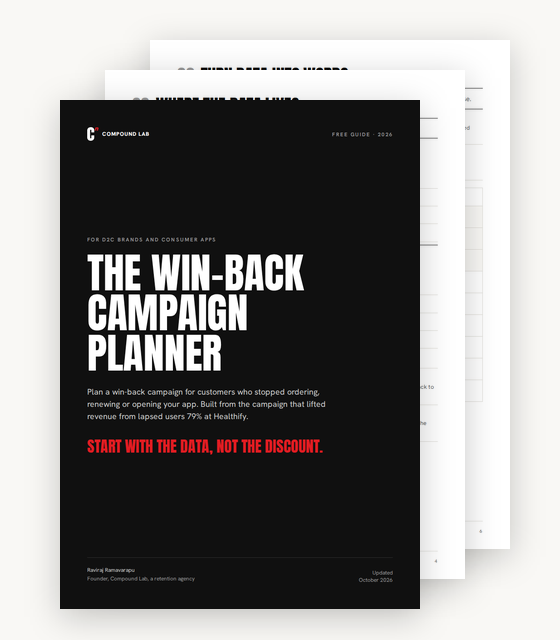
Free planner
Start with the data, not the discount.
The win-back campaign planner. How I find the customer data a win-back message needs, and turn it into words, in one PDF.
- A four-step method to find the data you already hold
- Where that data lives, with real examples from brands I’ve worked with
- A data-to-words worksheet, the four-block message and a results tracker
Sent. Check your inbox.
The planner is on its way to .