
WhatsApp Marketing Messages API 2027 Deadline
Meta ends marketing messages on the WhatsApp Cloud API on 13 Oct 2027. What the Marketing Messages API (formerly MM Lite) means for brands, and 4 steps.
Updated October 2026.
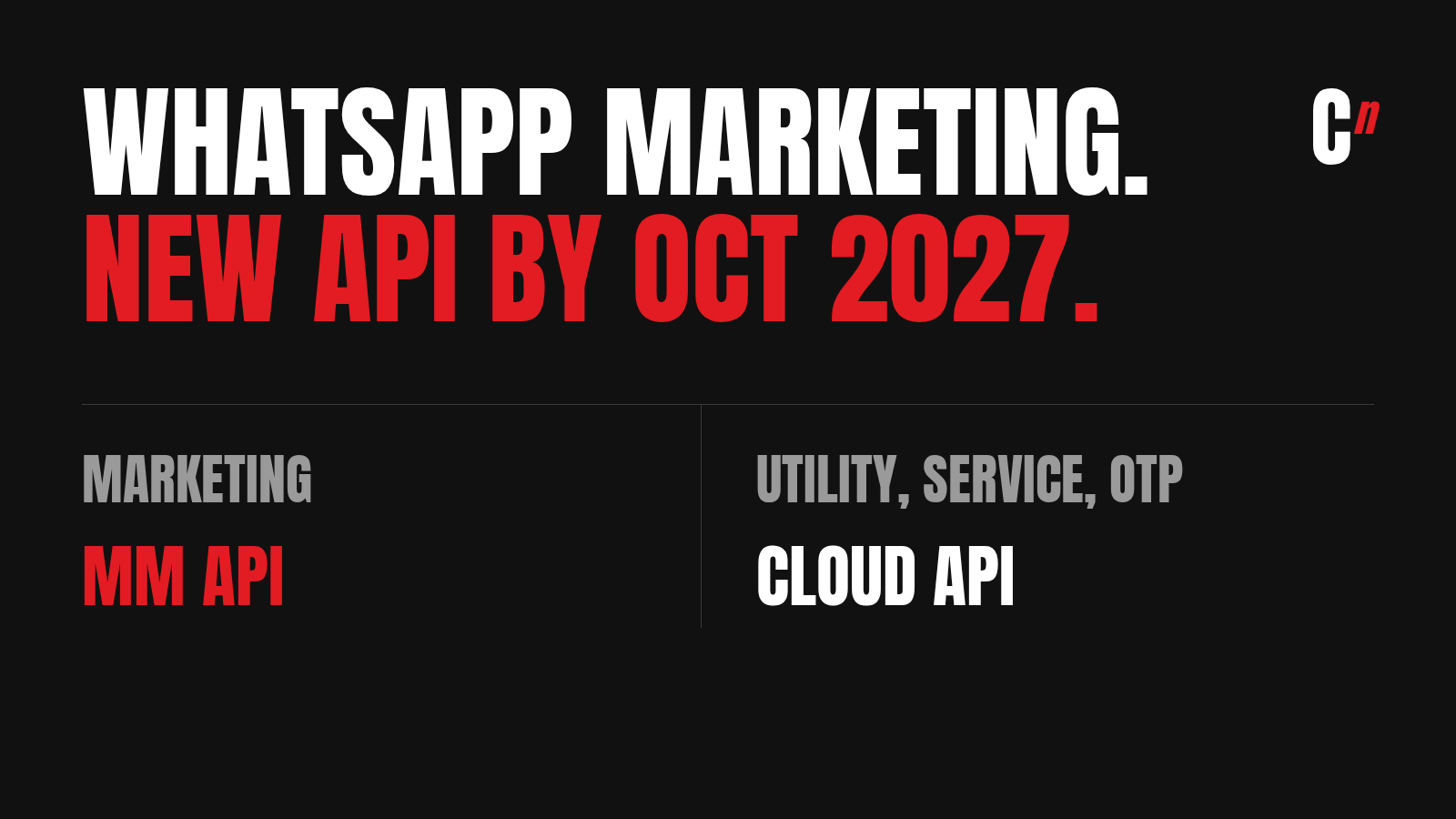
The Marketing Messages API for WhatsApp (MM API, earlier called MM Lite) is the API Meta now wants every marketing message to go through. On 14 October 2026, Meta told businesses that marketing messages on the Cloud API will stop on 13 October 2027. From that date, every WhatsApp marketing template has to go through the MM API. Utility, service and authentication messages stay on the Cloud API.
So if your brand sends offers, cart reminders or win-back messages on WhatsApp, the way they're sent will change within 12 months. Most of that work sits with your provider. A few parts sit with you, and one of them can quietly break your order updates if nobody checks it.
I got Meta's notice like every other business on the platform. This post covers what it says, what the MM API changes, what it costs in India, and the four things a D2C brand should do now.
What Meta announced
The notice, sent on 14 October 2026, says four things:
- Marketing messages on the Cloud API sunset on 13 October 2027. After that, all marketing message delivery goes through the Marketing Messages API for WhatsApp.
- Everything else stays where it is. Service, authentication and utility messages continue on the Cloud API.
- You have up to 12 months to upgrade. Meta says most integrations take about two weeks.
- Reclassified traffic must follow. If Meta reclassifies one of your utility templates as marketing, it has to be sent through the MM API, and your integration has to recognise that and route it.
Meta asks businesses to do three things: accept the MM API terms, confirm the integration is live on the MM API endpoint, and check reclassified traffic.
What the Marketing Messages API is
The MM API is a separate endpoint for marketing templates. Your number, your templates and your billing model stay the same. What changes is how Meta delivers the message.
On the Cloud API, a marketing template goes out through the standard /messages endpoint. On the MM API it goes through /marketing_messages, and Meta applies what it calls quality-based delivery: it prioritises marketing messages that people are likely to read and click. Meta's features page puts the gain at up to 9% more deliveries than the Cloud API. The footnote matters for Indian brands: the test behind it used about 12 million delivered marketing messages from advertisers in India, in January 2025, and covered high-engagement messages only.
Meta renamed the product from Marketing Messages Lite API to the Marketing Messages API for WhatsApp in November 2025, according to its changelog. Many providers' pages still call it MM Lite. It's the same product.
MM API vs Cloud API: what you get
| Feature | Cloud API | MM API |
|---|---|---|
| Marketing templates after 13 Oct 2027 | No | Yes |
| Utility, service and authentication messages | Yes | No, these stay on the Cloud API |
| Quality-based delivery (up to 9% more deliveries in Meta's test) | No | Yes |
| GIF headers and Android app deep links | No | Yes |
| Expiry time (TTL) on marketing messages, 12 hours to 30 days | No | Yes |
| Conversion metrics: add to cart, checkout, purchase | No | Yes |
| Benchmarks against similar businesses, and recommendations | No | Yes |
| Automatic creative optimisations | No | Yes, off by default since April 2026 |
| Carousel, catalogue, flows, lists and reply buttons | Yes | Yes |
| Cost per delivery and per click | Yes | Yes |
Source: Meta's MM API features page and changelog, October 2026. Meta also says some optimisation features are restricted by geography. Its changelog names groups such as the EEA; India is where it ran the delivery test above.
Two of these are worth using from day one. The expiry time stops a "sale ends tonight" message from landing two days late. Conversion metrics show which template led to purchases, not just reads, provided your links are set up the way Meta's conversion measurement guidance asks.
What it costs in India
The billing model doesn't change. Meta charges per delivered marketing message, at ₹0.8631 in India before GST, and your provider adds its markup. I've broken down the full rate card and provider markups in WhatsApp API pricing in India.
Two things are new.
More deliveries means a bigger bill. You pay for delivered messages. If the MM API delivers 9% more of a 1 lakh send, that's about 9,000 more deliveries and about ₹7,800 more before GST. That's money well spent if those people click and buy, and wasted if they don't. Judge the change on orders, not on delivered counts.
Max price. Meta is testing a setting that caps what you pay per delivered marketing message. It entered open beta on 1 October 2026, and Meta's pricing page says it becomes required in "eligible geographies" when it's generally available in Q2 2027. Meta hasn't said which countries those are. Templates without a max price pay the standard rate card. If your provider offers it, test it on one campaign before you set it everywhere.
The trap: utility templates that become marketing
This is the line in Meta's notice most brands will skip, and the one that can cost them.
Meta reviews template categories. If a utility template carries a promotion, such as an order confirmation that also says "use code SAVE10 on your next order", Meta can reclassify it as marketing. Today that mostly changes the price. After the sunset, a reclassified template sent through the Cloud API can fail, because marketing no longer goes there. Meta's notice says it has to route to the MM API, and your integration has to detect the new category.
So the risk is real: an order update or a delivery update, which customers expect, fails because someone added an offer to it a year ago. I explain the categories and what keeps a template in utility in my post on WhatsApp template approval.
What a D2C brand should do now: four steps
Most Indian D2C brands send WhatsApp through a provider, such as Kwik Engage, Interakt, AiSensy, Wati, Gupshup, or an engagement platform like MoEngage, CleverTap or WebEngage. If that's you, the code changes are your provider's job. These four are yours.
1. Ask your provider three questions. - Are you integrated with the Marketing Messages API, and by what date will all our marketing sends go through it? - Do you route utility templates that Meta reclassifies as marketing to the MM API automatically? - Will you pass on MM API features: expiry time, conversion metrics, max price?
If the answer to the first is "not yet", ask for a date in writing. Meta gave until October 2027, but the delivery gain starts the day you move.
2. Accept the MM API terms. Someone with full control of your Meta business portfolio has to do this. In WhatsApp Manager, go to Overview, find the alert in the Alerts section and click Accept terms. Meta's onboarding guide also needs your number to be on the Cloud API and your account to be in good standing. If your provider set up the account, it may not have this access, so check who in your company does.
3. Audit your utility templates. List every utility template and remove anything promotional: discount codes, "shop now" buttons, new launches. Keep order, shipping and payment messages purely about the order. Anything you want to promote goes in a separate marketing template.
4. Measure the move. For two weeks before and after the switch, track delivered out of sent, reads, clicks and orders per template, plus error 131049 counts. If your provider can split one campaign across both endpoints, that's the cleanest test.
Brands that call the Cloud API directly, without a provider, also need to move marketing sends to the /marketing_messages endpoint and handle the MM API's own error codes. Meta's get started guide covers the developer side.
Does it actually improve delivery?
Meta's own number is up to 9% more deliveries, from its India test. Some provider pages say "up to 30% more reach" or "5% to 30%" without showing a test. Treat those as sales copy.
The most specific public example I found is from Karix, a Tanla company, on Zepto. Zepto was retargeting dormant users and hitting WhatsApp's frequency limits. After moving from the Cloud API to MM Lite, Karix's case study reports a 16% uplift in delivery and a 65% delivery rate. It's a vendor's case study: it doesn't say how the uplift was measured or over what period, and reports no read, click or order numbers. It's still useful for one point. The gain came on dormant users with real purchase signals, like past frequent buyers and people with cart activity, not on a blast to everyone.
That matches what I've seen. When I took a premium cookware brand's WhatsApp delivery from 23% to 44% in a month, the fix was in the signals Meta reads: how often we sent, whether customers replied to the marketing number, and whether each message was triggered by something the customer did. The MM API builds on the same signals. It favours messages people engage with, so it rewards brands that already message well and does little for a brand that blasts its whole list every week.
If your reports are full of error 131049, the per-user marketing limit, the MM API alone won't clear it. Fewer, better-targeted messages will. Then the MM API adds its few percent on top.
Where I fit
The switch itself is a provider task. Making it pay off is a retention task: which templates go where, what stays utility, what to send to whom, and whether the extra deliveries turn into orders. Compound Lab is a retention agency that runs WhatsApp marketing for D2C brands, and that's the work. Book a 30-minute call and bring your template list. We'll find the utility templates at risk and plan your move before your provider's deadline, not Meta's.
FAQ
What is the Marketing Messages API for WhatsApp?
It's Meta's API for sending WhatsApp marketing templates through the /marketing_messages endpoint. It uses your existing number, templates and billing, and adds quality-based delivery, expiry times, GIF headers, conversion metrics and benchmarks. It was called the Marketing Messages Lite API, or MM Lite, until November 2025.
When do marketing messages on the WhatsApp Cloud API stop? On 13 October 2027, according to Meta's notice to businesses of 14 October 2026. After that, all WhatsApp marketing messages go through the Marketing Messages API.
Will my order and delivery updates stop working? No. Utility, service and authentication messages stay on the Cloud API. The exception is a utility template that Meta reclassifies as marketing because it carries a promotion. That template has to go through the MM API, so remove offers from your utility templates.
Is MM Lite the same as the MM API? Yes. Meta renamed the Marketing Messages Lite API to the Marketing Messages API for WhatsApp in November 2025. Many providers still use the old name.
Does the Marketing Messages API cost more? The rate per delivered message is the same rate card, ₹0.8631 per marketing message in India before GST. Because it can deliver more messages, your total bill can rise with the extra deliveries. Meta's max price setting, in open beta since October 2026, lets you cap the price per delivery.
I use a provider like Kwik Engage, Interakt or AiSensy. Do I need to do anything? Yes, three things. Ask your provider when your marketing sends move to the MM API. Have someone with full control of your Meta business portfolio accept the MM API terms in WhatsApp Manager. And remove promotions from your utility templates.
How long does the switch take? Meta says most integrations take about two weeks. For a brand on a provider, accepting the terms takes minutes. The provider's integration is the longer part.
Does the MM API work for messages to Indian numbers? Yes. Meta's delivery test was run on advertisers in India. Meta says some optimisation features are restricted in certain regions, and its documentation names groups such as the EEA, not India.
Moving your WhatsApp marketing to the MM API? Book a 30-minute call.
Free audit
Watch delivered, not opened.
The WhatsApp delivery audit. The checks I ran at Cumin Co, from reading error codes to frequency, replies and retries, in one PDF.
- How to read 131049 and five other failure codes
- Checks on trust, replies, frequency, journeys and retries
- A grid to score every message, and an 8-week tracker
Sent. Check your inbox.
The audit is on its way to .