
WebEngage vs MoEngage for D2C Brands (2026)
MoEngage vs WebEngage from an operator who ran both on D2C websites: WhatsApp retries, pop-ups, analytics, support, pricing and which to pick.
Updated October 2026.
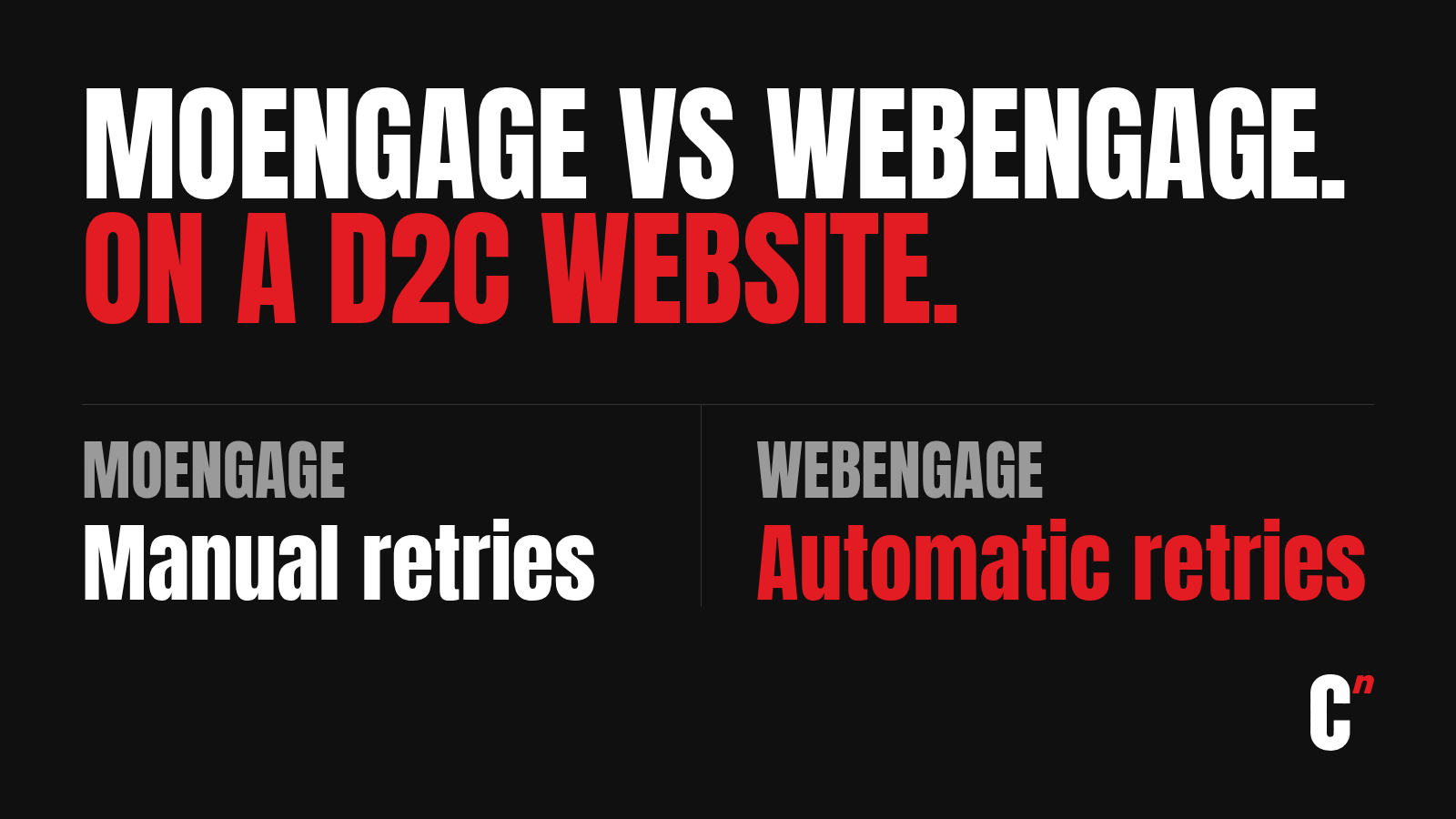
For a D2C brand that sells through its website, WebEngage is the better fit of the two. It retried failed WhatsApp messages automatically, its campaign reporting was easy to act on, and email worked well. MoEngage is a capable platform, but on a website it gave us more than we needed, and less of what mattered most. It had no automatic WhatsApp retries, and no pop-ups in our plan to capture new visitors.
This is a rare like-for-like comparison. I ran MoEngage at Cumin Co and WebEngage at PNG Jewellers, both D2C brands selling on their own websites.
MoEngage vs WebEngage at a glance
| Item | MoEngage | WebEngage |
|---|---|---|
| Best for | Large brands, or brands with an app | D2C brands selling on their website |
| Automatic WhatsApp retries | Not available | Yes, we used them |
| Pop-ups to capture visitors | Not in our plan | Hard to customise in 2025, since rebuilt |
| Analytics | Easy web funnels, newer interface | Clear campaign and revenue reporting |
| Worked fine | Worked well | |
| Support | Tickets and email | Paid retention service available |
| Published pricing | Not on its own site | Not on its own site |
WhatsApp retries: the difference that shows up in revenue
When a WhatsApp marketing message fails, the most common reason is Meta's limit on how many marketing messages one person can receive. Meta's guidance is to wait 24 hours before retrying. Every failed message you never retry is a customer you never reached.
On WebEngage, we used automatic retries. Failed messages were sent again without anyone rebuilding a list.
On MoEngage, there was no automatic retry. Every retry meant building a segment of the people a message had failed for, and sending the campaign again by hand. That takes time each week, and it muddies your delivery reporting, because the retries show up as new campaigns.

If WhatsApp drives your repeat revenue, this one difference can decide it. Even without automatic retries, the channel can recover: on the same MoEngage setup, Cumin Co's WhatsApp delivery rate went from 23% to 44% in a month. It just took more manual work than it should have. I've written more about why failed messages matter in why your WhatsApp messages aren't being delivered.
Pop-ups and capturing new visitors
For a D2C brand paying for traffic, collecting a visitor's details before they leave is where retention starts.
On MoEngage, pop-ups weren't in our plan at Cumin Co, so we had no built-in way to capture visitors.
WebEngage had them, with triggers for exit intent, cart pages and specific collection URLs. At PNG Jewellers, you could show a rings-specific pop-up on the rings collection. The problem was design. Getting a clean, on-brand pop-up was hard, and for a jewellery brand, how it looks matters. WebEngage told us the feature was in beta and offered to build our pop-ups if we sent them the HTML. An ecommerce brand shouldn't need a coder to build a form.
That's since been fixed. WebEngage has rebuilt its on-site notifications with a drag-and-drop editor that needs no HTML. I haven't used the new version, so test it with your own designs before relying on it.

MoEngage vs WebEngage analytics
Both tracked the web funnel well once our events were set up: browse, collection, product page, cart, checkout and purchase. MoEngage's interface is newer and cleaner to look at.
WebEngage's strength was campaign reporting. A single table showed which campaigns were working and which weren't, with reach and revenue for each, plus day-on-day revenue trend lines. It wasn't the most detailed breakdown, but it answered the question we asked most often: what's actually making money? That reporting is a big part of why automations drove 77% of PNG Jewellers' CRM revenue. We could see which flows earned, and build more of them.
Support, and what a vendor's retention service is worth
This is where the two differ most, and where founders get pitched hardest.
WebEngage offered a paid retention service on top of the platform, priced at roughly ₹60,000 to ₹75,000 a month for us. It was useful for onboarding and for learning how to run things ourselves. When we hit a technical problem, they were quick to resolve it.
Where it fell short was strategy. The ideas were generic, not sharp enough to move revenue for our brand specifically. They offered to plan and run campaigns, but a service sold alongside a platform is built to support that platform first, and it showed.
MoEngage had no equivalent. Support ran through tickets and email. If something didn't work, you raised a ticket and waited for a reply.
So if a vendor offers you a retention service, judge it on one thing. Will it come up with ideas specific enough to grow your revenue? Technical support is worth having. Generic strategy isn't worth paying extra for.

MoEngage vs WebEngage pricing and fit
Neither publishes prices on its own site. Both quote based on your audience size and the features you choose. On MoEngage, some features we wanted, like dynamic product content in messages, were paid extras. Its current AWS Marketplace listing shows the Growth package at $750 a month for up to 25,000 tracked users, with advanced analytics and WhatsApp billed on top.
The bigger issue at Cumin Co was fit. We chose MoEngage partly because an app was planned, and MoEngage is strong for apps. Until that app existed, we were paying for app capabilities we didn't use. Buy for the business you're running now, not one on a roadmap.
Before you compare quotes, work out what one customer is worth to you, so you know what the platform has to earn back. The customer lifetime value calculator does it from four numbers in your Shopify reports.
Free checklistEvery question to ask before you sign, for all four platforms, in one fillable PDF. Get the free checklist
Which should you pick?
Pick WebEngage if you're a D2C brand selling through your website and WhatsApp drives your repeat revenue. Automatic retries and clear campaign reporting make the day-to-day work easier.
Pick MoEngage if you already have an app, or you're large enough to use what you pay for. It's built for apps first. If your app is the main channel, see CleverTap vs MoEngage.

Still on a WhatsApp-first tool? See Kwik Engage vs WebEngage.
If you're just starting out, a full engagement platform may be more than you need. A WhatsApp-first tool like Kwik Engage is often enough, as I explain in the four-platform comparison. If you're still narrowing the field, start with the guide to choosing a CRM platform. For a closer look at each platform on its own, see my MoEngage review and WebEngage review.
Where I fit
Compound Lab is a retention agency. Before you pay for a platform's retention service, it's worth a second opinion on what you'll actually get. Book a 30-minute call and I'll look at your setup, your platform and what's worth building first. If you need help deciding who should run retention at all, I've broken that down in who should run retention for your D2C brand.
FAQ
Who are WebEngage's main competitors? MoEngage and CleverTap are the closest, with Netcore and Insider also common in Indian shortlists. For a young Shopify brand that mostly needs WhatsApp, a lighter tool like Kwik Engage is often the real alternative, as I explain in Kwik Engage vs WebEngage.
Is WebEngage better than MoEngage for D2C brands? For brands selling through their website, WebEngage was the better fit for us. It retried failed WhatsApp messages automatically and had clearer campaign reporting. MoEngage suits larger brands and brands with apps.
Does WebEngage retry failed WhatsApp messages? Yes. We used automatic retries on WebEngage at PNG Jewellers. MoEngage required manual re-sends.
Does WebEngage have pop-ups? Yes, with triggers for exit intent, cart pages and specific URLs. In 2025 they were hard to design without HTML. WebEngage has since rebuilt them with a drag-and-drop editor, so test the new version with your own designs.
How much do MoEngage and WebEngage cost? Neither publishes prices on its own site, and both quote on audience size and features. MoEngage's AWS Marketplace listing shows its Growth package at $750 a month for up to 25,000 tracked users, with WhatsApp and advanced analytics billed on top.
Is WebEngage's retention service worth paying for? It helped with onboarding and technical issues, but the strategy was generic for us. At roughly ₹60,000 to ₹75,000 a month, judge it on whether it brings ideas specific to your brand.
Should I choose MoEngage if I plan to launch an app? Only if the app is close. Until it exists, you pay for capabilities you don't use. Choose for the business you run today.
Choosing between MoEngage and WebEngage? Book a 30-minute call and get a straight answer.
Free checklist
Buy the plan, not the demo.
The CRM platform buyer’s checklist. Every question to ask CleverTap, MoEngage, WebEngage and Kwik Engage before you sign, in one PDF.
- Questions on plans, pricing, data, delivery, support and leaving
- A page of questions for each of the four platforms
- A scorecard to compare your shortlist side by side
Sent. Check your inbox.
The checklist is on its way to .