
The Message Museum · For CRM, retention and lifecycle roles
Write CRM messages for WhatsApp, email and SMS, and know why each one works
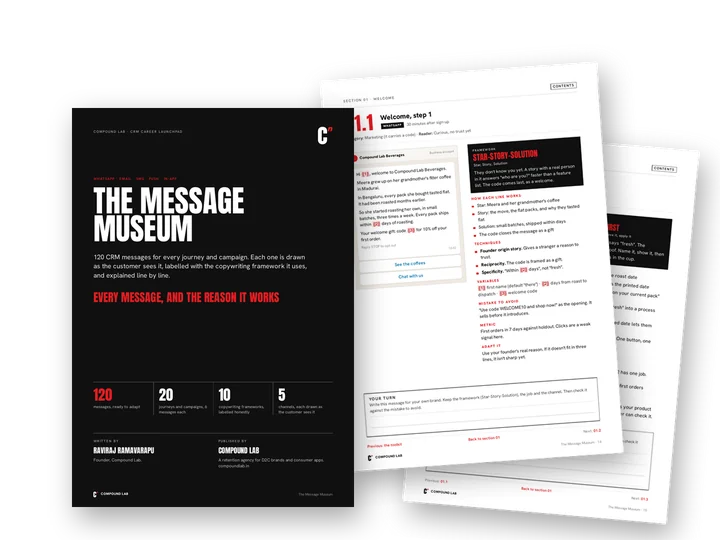
120 messages across 20 journeys and campaigns, each drawn as the customer sees it and explained line by line. Even if you’ve never written a marketing message before.
Free for the first 100 learners
One honest review in return. ₹499 after that.
of 100 places left · learners already in
No payment, no card. The folder link arrives by email in a minute.
- 155-page PDF and a copy-paste Word file
- Self-study: a guide and a copy-paste file
- Written by the founder of a retention agency

Raviraj Ramavarapu
Founder, Compound Lab · 7 years in D2C and app marketing, most in CRM · has hired for CRM roles
“I built this from the work I do every day for brands. Practise it here before you do it on the job.”
- +79%revenue from lapsed usersHealthify
- 23% to 44%WhatsApp delivery in a monthCumin Co
- 77%of CRM revenue from automationsPNG Jewellers
- 39%of store revenue from CRMHealthify Store
- +43%return pickupsMyGate
- ₹27.6 Crrun-rate across Healthify, PNG Jewellers and DS MillRetention I’ve run









Who it’s for
It’s for you, even if you’ve never written copy
- Never written marketing copyEvery message is explained line by line, so you see how it’s built.
- Don’t know any frameworksTen frameworks, simple shapes for a message, each with when to use it and an example.
- Never seen a brand’s WhatsAppEach message is drawn as the customer sees it, buttons and footer included.
- Not working at a brand yetEvery message uses one made-up brand, Compound Lab Beverages, so no company access is needed.
- WhatsApp and SMS rules confuse youThe Meta and DLT rules sit on one page, and every message follows them.
Built for marketing CRM: the messages a brand sends on WhatsApp, email, SMS, push and in-app. If you want finished email designs or Salesforce and sales pipelines, skip this one.
What you walk in with
Eight things you’ll do better in every message you write
- Pick the right framework for the momentStart from what the reader already knows. The framework follows.
- Explain why your message worksEvery line has a reason, so you can defend your copy, not just paste it.
- Write for five channels, not oneWhatsApp, email, SMS, push and in-app, each with its own limits.
- Get WhatsApp’s message types rightOrder updates go as Utility, with no selling. Add an offer and Meta moves it to Marketing.
- Write SMS that follow India’s DLT rulesEvery brand SMS must match a registered template. Each one here is written that way.
- Stop handing out discounts by habitA discount 30 minutes after a cart pays people who would have bought anyway.
- Judge a message by orders, not opensEach journey holds back 5% who get nothing, so you can compare orders.
- Never start from a blank screenSix messages for each journey, from welcome to win-back to Diwali.
Pick the better message
Which one would you send?
From page 36 · Cart journey, step 2
Someone added the Filter Coffee Blend to their cart 6 hours ago. They got one reminder already and still haven’t ordered. What goes out next on WhatsApp?
A cart journey is the short series of messages a brand sends after someone leaves items in their cart.
Pick the one you’d send.
A second reminder won’t help. They’ve been reminded already; a doubt is holding them back, and this doesn’t touch it.
This is the kit’s message. It answers the doubt they didn’t say, makes it real in one line, then removes it with a free swap.
A discount doesn’t answer the doubt, and many would have bought anyway, so you give money away for nothing. The kit tests free delivery before any percentage, and only at step 3.
Why it works
It uses PAS (Problem, Agitate, Solve): name the doubt, sharpen it in one line, then remove it. More than one line of pain turns help into a scare.
The kit’s tip
“Read your support chats. The most common pre-purchase question is your step 2.”
That’s one page of the kit. See it as it is:
One message, taken apart
Every message comes with its reasons
This is the first welcome message, laid out the way all 120 are. On the left, the WhatsApp as the customer sees it; on the right, why it was written that way.
What you get
- The message: Meera’s story of her grandmother’s filter coffee, then a 10% welcome code
- Why Star-Story-Solution: a real person answers “who are you?” faster than a feature list
- What changes per customer: their name, days since roasting, the welcome code
- The mistake to avoid: opening with “Use code WELCOME10 and shop now!”
Look inside
Real pages from the kit
The Meta, DLT and email rules every message follows
How to pick a framework from what the reader knows
A welcome WhatsApp, taken apart line by line
A welcome email layout, with the reason behind it
Cart reminder 2: answer the doubt they didn’t say
A cart SMS written in DLT format
An app push: two lines, one tap
A Diwali gift message, explained line by line
What’s in the folder
One guide, one copy-paste file
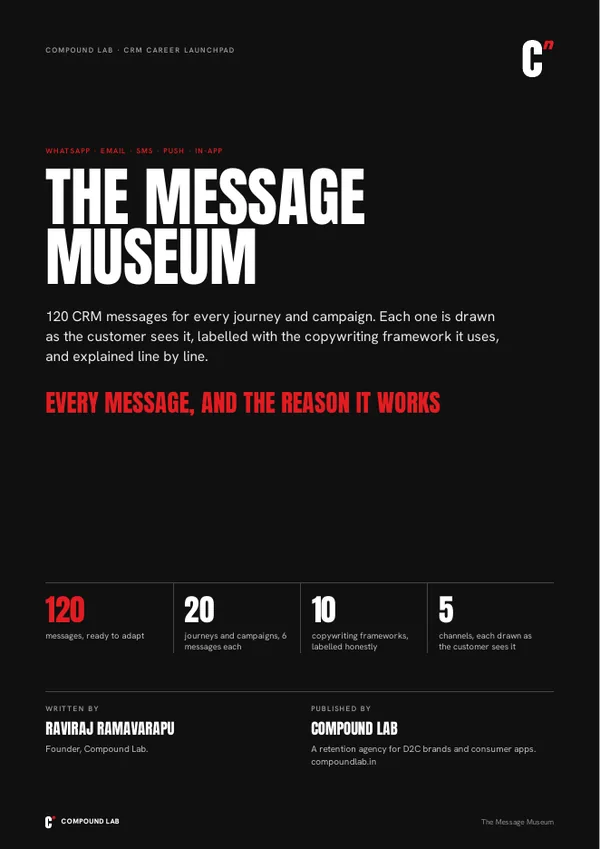
PDF · 155 pages
The guide
All 120 messages, one per page, with the framework, why each line works, the mistake to avoid and how to judge it.
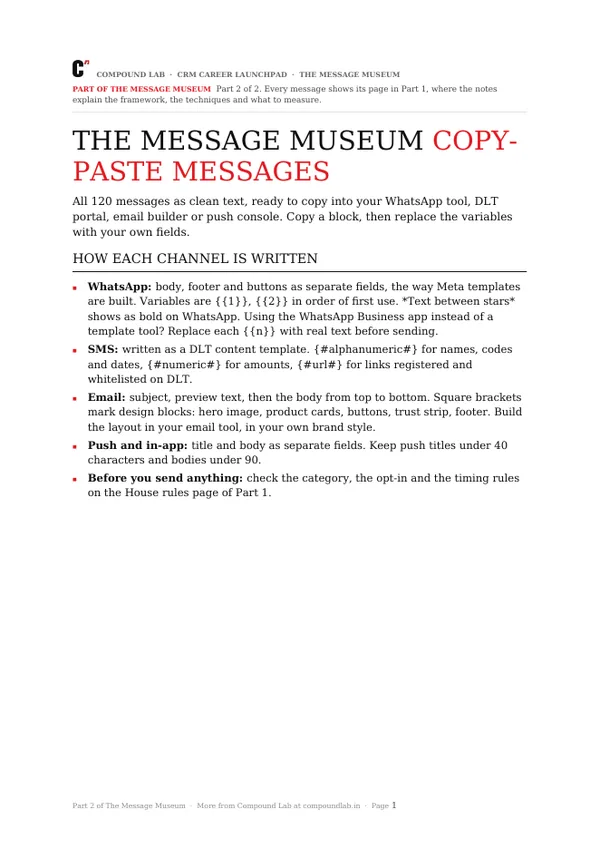
Word file
Copy-paste messages
Every message as clean text, with its page number in the guide, ready to paste and adapt.
The copy-paste file opens in Word or Google Docs.
The founding batch
Free for the first 100, for one honest review
- Get it freeName, email, WhatsApp. The link arrives by email in a minute.
- Use it for a weekRewrite one message a day for your brand.
- Tell me honestlyFour short questions. Good or bad.
After the founding batch, the Message Museum sells for ₹499.
Questions, answered
I’ve never written marketing copy. Will this work for me?
Yes. Every message is explained line by line, and the ten frameworks are each shown with an example first. Each page ends with a task: write the same message for your own brand.
What is the difference between a Utility and a Marketing WhatsApp template?
Utility is about something the customer started, like an order update, with no offer and no selling. Add selling and Meta moves it to Marketing. Every WhatsApp message in the kit is labelled with its category.
Do the SMS messages follow DLT rules?
Yes. Every SMS is written with DLT’s typed variables, like {#numeric#} for amounts, and shows the header ending: -P promotional, -S service, -T transactional. You still register them on DLT yourself.
Can I use these in WebEngage, CleverTap or MoEngage?
The messages are plain text with the changing parts marked, so you can paste them into any tool where you write templates. The kit doesn’t cover each tool’s setup screens.
How long does it take?
No need to read it in order. Read the framework pages first, then one journey of six messages a day. Twenty journeys and campaigns take about three weeks that way.
What do I get, and in what format?
A 155-page PDF guide and a Word file with every message as clean text. The Word file opens in Word or Google Docs. The link arrives by email.
Who is this not for?
Sales CRM roles like Salesforce admin. And anyone after finished email designs: the email layouts are reference designs to start from, not templates to ship.
Why is it free right now?
The first 100 learners get it free as the founding batch, in return for one honest review after a week. After that it sells for ₹499.
Do I get a certificate?
No. You get messages you can write and explain, which is what a brand or an interviewer will judge.
The Message Museum
Rewrite one welcome message for a brand you love tonight
Free for the first 100 learners
One honest review in return. ₹499 after that.
of 100 places left · learners already in
No payment, no card. The folder link arrives by email in a minute.
 CRM Career Launchpad
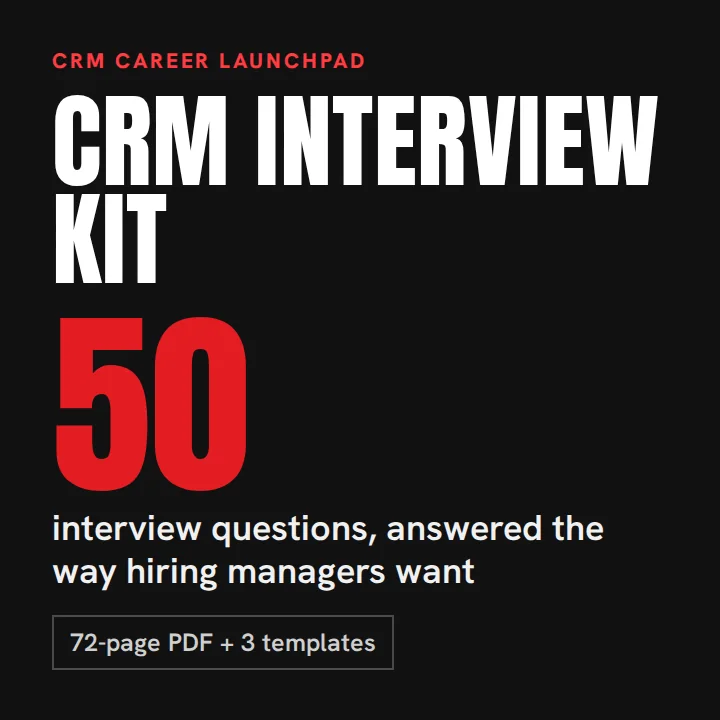 CRM Interview Kit
 CV, LinkedIn and Portfolio Kit
 CRM Practice Projects
 Journey Blueprints
 CRM Analyst Workbook
 How to Learn CRM Tools
 The CRM Prompt Pack
 CRM Glossary