
CRM Glossary: 80 Marketing Terms and Acronyms
CRM glossary: 80 marketing terms in plain English, 30 CRM abbreviations and acronyms with full forms, and what MoEngage, CleverTap and WebEngage call each.
Updated October 2026.
CRM stands for customer relationship management. In marketing, it means the team, tools and messages that bring existing customers back to buy again. This CRM glossary explains the 80 terms you will hear most in a CRM, retention or lifecycle marketing job, each in one line and grouped by topic, then lists 30 CRM abbreviations and acronyms with their full forms. Where tools use different names for the same idea, I give one plain name and show what MoEngage, CleverTap and WebEngage call it.
CRM means something else in other fields, such as crew resource management in aviation. This page is about marketing CRM.
I've run CleverTap at Healthify and MyGate, WebEngage at PNG Jewellers as the retention agency managing its CRM, and led retention on MoEngage at Cumin Co.
New to the field? Start with what CRM marketing is.
CRM basics
| Term | What it means |
|---|---|
| CRM | Customer relationship management. In marketing, the work of keeping existing customers buying, using their data and messages. |
| CRM marketing | Messaging customers who have already signed up or bought, so they come back. Also called retention marketing. |
| Lifecycle marketing | CRM marketing planned around customer stages, from sign-up to repeat buyer to lapsed. |
| Customer engagement platform (CEP) | A tool that stores customer data and sends messages across channels. MoEngage, CleverTap and WebEngage are CEPs. |
| Customer data platform (CDP) | A tool that unifies customer data from many sources and passes it to other tools. |
| MAU | Monthly active users. Many CRM tools price by it. |
I explain how CEPs and CDPs differ in CEP vs CDP.
Customer data terms
| Term | What it means |
|---|---|
| User profile | One record per person, holding who they are and what they did. |
| User ID | Your own unique ID for a known person, sent at login so every device maps to one profile. |
| Profile merge | Joining an anonymous or duplicate profile into the known one. Also called identity resolution. |
| User attribute | A fact on a profile with one current value, such as city or plan. Also called a user property. |
| Event | A timestamped record of one thing a person did, such as Added to Cart. Each repeat is a new event. |
| Event attribute | A detail on one event, such as the product name. Also called an event property. |
| Purchase event | The event that records an order and its value. Most revenue numbers come from it. |
| SDK | Code added to the app or website that sends profiles and events to the tool. |
| Push token | The unique address a phone gives an app so it can receive push notifications. It is lost when the app is uninstalled. |
| Product catalog | A feed of products, prices and stock that the tool uses for recommendations and product blocks in messages. |
Audience and segmentation terms
| Term | What it means |
|---|---|
| Segment | A group of users defined by rules, such as "ordered twice, lives in Pune". It updates itself. |
| Static list | A fixed set of users, usually from a CSV, that only changes when you edit it. |
| RFM | Scoring customers on Recency, Frequency and Monetary value to group them. |
| Predictive segment | Users grouped by how likely a model thinks they are to buy, churn or uninstall. |
| Churn | When a customer stops buying or using the product. Churn rate is the share who do. |
| Lapsed customer | Someone who hasn't bought within their usual gap between orders. The usual audience for win-back. |
How each behaves inside a journey is covered in flows vs campaigns.
Journey and campaign terms
| Term | What it means |
|---|---|
| Campaign | A single message sent to a segment, once or on a repeating schedule. |
| Journey | An automated, multi-step path with waits and branches. Called a flow in MoEngage and Klaviyo, and a Canvas in Braze. |
| Triggered campaign | A single message sent automatically when someone does, or doesn't do, something. |
| Entry trigger | The rule that puts a person into a journey: an event, a segment, a date or an API call. |
| Wait | A step that holds a person for a set time, or until they act. Also called a delay. |
| Conditional split | A step that sends people down different paths based on who they are or what they did. |
| A/B split | A step that sends random shares of people down different paths to see which works better. |
| Exit criteria | Rules that take a person out of a journey early, such as "they bought". |
| Abandoned cart journey | Messages sent after someone adds to cart but doesn't order. |
| Browse abandonment | Messages sent after someone views products but doesn't add any to cart. |
| Win-back campaign | Messages to lapsed customers to bring them back. Reactivation rate is the share who buy again. |
| Replenishment reminder | A message timed to when a customer's last purchase is likely to run out. |
| Send time optimisation | The tool picks each person's send time from when they usually engage. MoEngage calls it Best Time to Send, CleverTap IntelliTime and WebEngage Send Intelligently. |

Channel terms
| Term | What it means |
|---|---|
| Push notification | A message that pops up on a phone from an installed app. Needs OS permission. |
| Web push | A browser notification from a website, shown even when the site is closed. |
| In-app message | A message shown inside the app during use. On websites, an on-site message or pop-up. |
| App inbox | A saved feed of messages inside the app that people can open later. |
| WhatsApp template | A message format Meta must approve before a brand can message someone first. |
| BSP | Business Solution Provider, the Meta partner that connects a brand to the WhatsApp Business Platform. |
| SMS DLT template | An SMS text registered on a DLT portal. Every commercial SMS in India must match one. |
| Principal Entity (PE) | The business registered on a DLT portal as the sender of SMS. |
| Header | The sender ID shown on an SMS, registered on DLT under the Principal Entity. |
| RCS | Rich messages in the phone's default SMS app, with images and buttons. Falls back to SMS. |
| Read rate | The share of delivered WhatsApp messages that were read. People who switch off read receipts are not counted. |
Sources: Meta's message templates documentation and WebEngage's TRAI SMS DLT regulations page, as of October 2026. Approval rules are covered in WhatsApp template approval and SMS DLT template.
Personalisation terms
| Term | What it means |
|---|---|
| Templating language | The placeholder syntax that pulls data into a message, such as Liquid or Jinja. |
| Fallback value | Text shown when data is missing, such as "there" instead of a blank first name. |
| Abort send | A rule that cancels a message for a person when key data is missing. |
Real syntax for each tool, with fallbacks, is in Liquid and Jinja personalization.
Guardrail and consent terms
| Term | What it means |
|---|---|
| Frequency capping | A limit on how many messages one person gets per day or week. |
| Quiet hours | Hours when the tool holds messages, such as at night. MoEngage, CleverTap and WebEngage call this DND. |
| NCPR (DND registry) | India's national Do Not Disturb register run under TRAI, separate from a tool's quiet hours. |
| Reachability | Whether the tool can reach a person on a channel now, with an address, consent and no bounce. |
| Opt-in status | The per-channel record of whether a person agreed to receive marketing. |
| Suppression list | People who must never get messages on a channel, such as hard bounces or unsubscribes. |
| Push opt-in rate | The share of app users who allowed push notifications. |
| Hard and soft bounce | A hard bounce is a permanent email failure, such as an address that does not exist. A soft bounce is temporary, such as a full inbox. |
| Sender reputation | How inbox providers rate your sending domain, based on bounces, spam complaints and engagement. Low reputation sends mail to spam. |
| Unsubscribe rate | The share of delivered messages that led someone to opt out of that channel. |
Measurement and analytics terms
| Term | What it means |
|---|---|
| Delivery rate | The share of sent messages that reached the person's device or inbox. |
| Open rate | The share of delivered messages that were opened. |
| Click-through rate (CTR) | The share of delivered messages that were clicked. |
| Conversion goal | The event that counts as success for a message, usually an order. |
| Attribution window | How long after a message a conversion still counts for that message. |
| View-through conversion | A buyer who got or saw the message but didn't click it. |
| A/B test | Sending different versions of a message to random groups, then picking the winner. |
| Control group | A random slice of a campaign's audience that gets no message, so you can measure what it added. |
| Global control group | A fixed slice of all users kept out of all marketing, to measure the whole CRM programme. |
| Incremental lift | The extra conversions or revenue the messaged group made over the control group. |
| Funnel | A report showing how many people finish each step, such as view, cart, checkout and order. |
| Cohort analysis | Groups people by when they first did something and shows what share came back later. |
| Repeat purchase rate | The share of customers who have bought more than once. |
| LTV | Customer lifetime value, the revenue or margin a customer brings over their whole time with you. |
| CAC | Customer acquisition cost, what you spent to win one new customer. |
| AOV | Average order value: revenue divided by the number of orders. |
| D1, D7, D30 retention | The share of new users still active 1, 7 and 30 days after they started. |
| DAU/MAU (stickiness) | Daily active users divided by monthly active users. The higher it is, the more often people come back. |
| Uninstall rate | The share of app users who uninstalled. Tools detect it with silent push notifications. |
| Statistical significance | How confident you can be that the gap between two versions in a test is real and not chance. |
| CRM revenue contribution | The share of total revenue credited to CRM messages. Read it against a control group, because attribution alone overstates it. |
How to size and read a holdout is in global control group. To compare LTV with CAC, use the customer lifetime value calculator.
CRM abbreviations and acronyms
These are the CRM abbreviations and acronyms you will see in job posts, dashboards and interviews, with their full forms.
| Abbreviation | Full form |
|---|---|
| A/B | A/B test: two or more versions sent to random groups to see which works better |
| AOV | Average order value |
| API | Application programming interface, how tools pass data to each other |
| ARPU | Average revenue per user |
| BSP | Business Solution Provider, a Meta partner for the WhatsApp Business Platform |
| CAC | Customer acquisition cost |
| CDP | Customer data platform |
| CEP | Customer engagement platform |
| COD | Cash on delivery |
| CRM | Customer relationship management |
| CTR | Click-through rate |
| CVR | Conversion rate |
| D1, D7, D30 | Day 1, day 7 and day 30 retention |
| DAU | Daily active users |
| DLT | Distributed Ledger Technology, the TRAI registration system every commercial SMS in India goes through |
| DND | Do not disturb: quiet hours in a CRM tool, or India's NCPR register |
| GCG | Global control group (WebEngage calls it UCG, universal control group) |
| KPI | Key performance indicator |
| LTV (CLV) | Customer lifetime value |
| MAU | Monthly active users |
| NCPR | National Customer Preference Register, India's Do Not Disturb list |
| NPS | Net Promoter Score |
| OTP | One-time password |
| PE | Principal Entity, the sender registered on DLT |
| RCS | Rich Communication Services, rich messages in the default SMS app |
| RFM | Recency, frequency, monetary value |
| RTO | Return to origin, an order that comes back undelivered, common with COD |
| SDK | Software development kit |
| STO | Send time optimisation |
| UTM | Urchin Tracking Module tags added to links to track where visits came from |
The full version of this glossary, with 216 terms, an Indian example for each and the pairs interviewers mix up, is the CRM Glossary PDF.
What MoEngage, CleverTap and WebEngage call these terms
The table below is based on each vendor's documentation, as of October 2026.
| Plain name | MoEngage | CleverTap | WebEngage |
|---|---|---|---|
| Journey | Flow | Journey | Journey |
| Static list | File segment | Custom - List Based Segment | Static List |
| User ID | ID (uid) | Identity | CUID |
| Templating language | Jinja | Liquid | Personalization tokens |
| Attribution window | Attribution window | Conversion Time | Conversion Deadline |
| App inbox | Cards | App Inbox | Notification Inbox |
| Global control group | Global Control Group | System Control Group | Universal Control Group |
Sources: MoEngage's pages on flows, file segments, Jinja and its global control group. CleverTap's pages on journeys, segment types, Liquid tags and control groups. WebEngage's pages on journeys, static segments and control groups. Tools rename features often.

Choosing a platform for a brand instead? See my CleverTap vs MoEngage vs WebEngage comparison.
How to use this glossary to learn CRM
- Learn the plain name first. Know what an idea does before learning its menu.
- Map it to one tool. Use the table above for the tool your target company runs.
- Explain one result. My win-back campaigns post shows a measured result written up end to end.
Where I fit
I'm Raviraj, founder of Compound Lab, a retention agency for D2C brands and consumer apps. To put these terms to work, follow my six-week roadmap to learn CRM tools, then follow the career path in my guide to becoming a CRM marketer, linked at the end of this page. Running a brand and need your CRM set up? Book a 30-minute call.
FAQ
What does CRM stand for? CRM stands for customer relationship management. In marketing, it means using customer data and messages, such as WhatsApp, email, SMS and push, to bring existing customers back. In aviation, CRM means crew resource management, which is unrelated.
What is CRM in simple terms? CRM is how a business remembers each customer and talks to them based on what they did. A brand that reminds you about the shoes left in your cart is doing CRM.
What is a CRM marketing glossary? A CRM marketing glossary is a list of the terms used in CRM, retention and lifecycle marketing, with plain definitions. A good one also shows what each tool calls the same idea.
What is the difference between a segment and a list in CRM? A segment is defined by rules and updates itself. A static list is a fixed group, usually uploaded as a CSV, that changes only when you edit it.
What is the difference between a journey and a campaign? A campaign is a single message sent to a segment, once or on a schedule. A journey is an automated, multi-step path with waits and branches.
What is a control group in CRM marketing? A control group is a random slice of a campaign's audience that gets no message. Comparing it with the messaged group shows how many extra conversions the message caused.
What are the 7 C's of CRM? There is no single standard list, and versions online use different sets of words starting with C. In a CRM marketing job, the ideas you will be asked about are segments, journeys, channels and how you measure lift.
What are the types of CRM? Most guides list three: operational, analytical and collaborative. That split comes from sales CRM software. In marketing, the CRM tools are customer engagement platforms such as MoEngage, CleverTap and WebEngage.
Is there a CRM glossary PDF? Yes. The CRM Glossary PDF has 216 terms in eight chapters, each with an Indian example.
Which CRM terms should a fresher learn first? Start with user profile, event, user attribute, segment, campaign, journey, control group and conversion goal. These eight ideas appear in every CRM tool, often under different names.
Know the words and want the job? The CRM Career Launchpad bundles the full glossary with interview prep, practice projects and templates for ₹699, and how to become a CRM marketer maps the path.
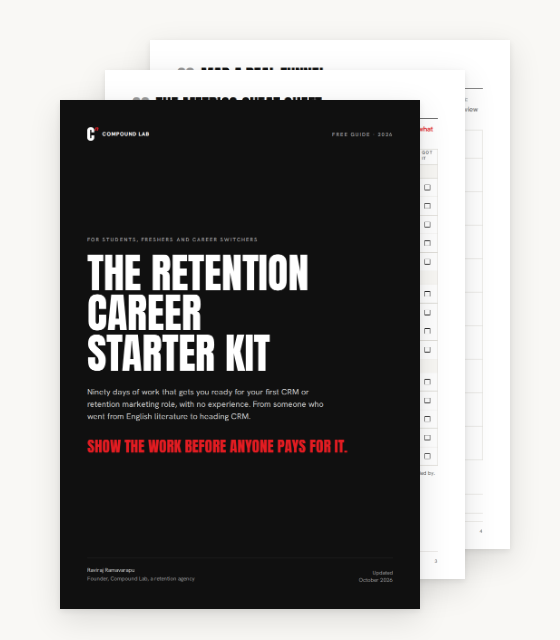
Free starter kit
Show the work before anyone pays for it.
The retention career starter kit. Ninety days of work that gets you ready for your first CRM or retention marketing role, in one PDF.
- A 90-day plan and a metrics cheat sheet for email, WhatsApp and the business
- A funnel map, a journey builder and a data project to show in interviews
- Interview questions to practise and a job tracker
Sent. Check your inbox.
The starter kit is on its way to .