
What Is a Customer Data Platform (CDP)? CDP vs CEP vs CRM
What a customer data platform (CDP) is, with examples, how it differs from a CEP and a CRM. Where MoEngage, CleverTap and WebEngage fit and when you need one.
Updated October 2026.
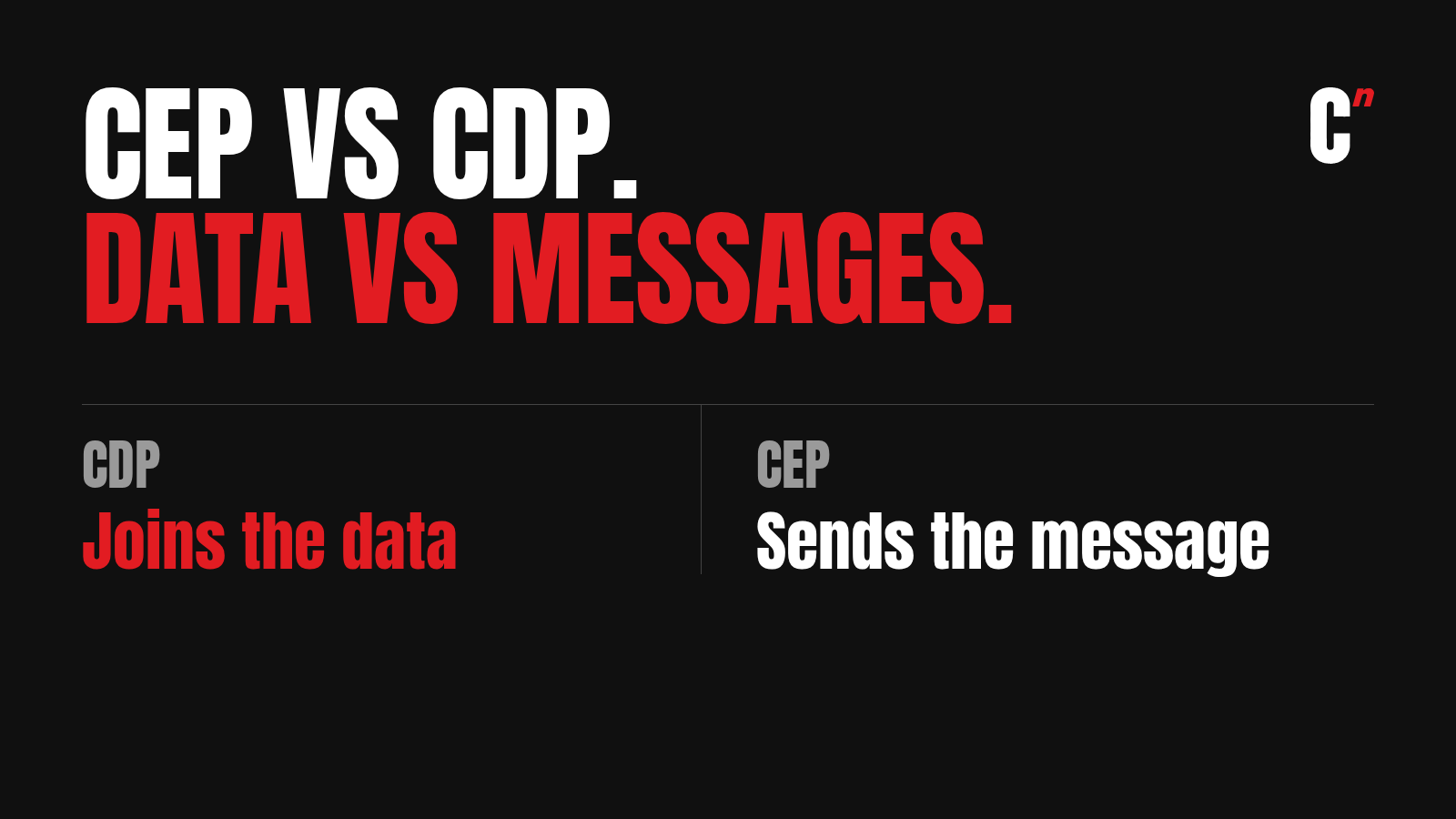
A customer data platform (CDP) is software that collects customer data from every source and joins it into one profile per person that other tools can use. A CEP (customer engagement platform) uses that data to send messages, such as push, WhatsApp, email, SMS and in-app, through campaigns and journeys. A CRM, in the original sense, is the record of customers, deals and tickets that sales and support teams work from.
This page is about software. In brand marketing, "CEP" also stands for category entry points, the moments that make people think of a category. That's a different topic.
I ran CleverTap at Healthify, where millions of users logged millions of events. That's exactly where the CEP vs CDP question stops being theory, because the CEP couldn't hold everything we wanted to keep. I cover what we did about it below.
What is a customer data platform (CDP)?
Analyst firm Gartner and the CDP Institute, an industry group, both define a CDP as software that unifies a company's customer data into one database that other systems can use. Their full definitions are quoted on cdp.com, as of October 2026. Wording gets revised, so check the current versions on Gartner's glossary and the CDP Institute's site.
In plain words, a CDP does four jobs.
- Collects events and attributes from the website, the app, the store, the call centre and offline sales.
- Matches records that belong to the same person, for example a phone number from WhatsApp and an email from checkout. This is called identity resolution.
- Keeps one profile per person that stays up to date.
- Sends audiences and profiles out to other tools, such as ad platforms and the CEP.
Most CDPs don't send a WhatsApp or a push themselves. Their output is clean data and audiences. A well-known example is Twilio Segment, which Twilio calls "our leading customer data platform" (Twilio, as of October 2026).
What is a CEP?
Braze, one of the global CEPs, defines it as "software that supports real-time, cross-channel customer engagement" (Braze, as of October 2026). The cdp.com glossary, run by a CDP vendor, puts the split neatly. It says a CEP "focuses on message execution", while a CDP focuses on "unifying the data that makes those messages relevant" (cdp.com).
A CEP is the tool a CRM marketer in India opens every morning. Inside it you build segments, campaigns and journeys, set frequency caps and quiet hours, and read conversion reports. If those words are new, my CRM marketing glossary covers each one, and flows vs campaigns explains the two ways to send.
What does CRM mean in "CRM marketing"?
Here is where most learners get confused. "CRM" has two meanings in Indian job posts.
The software meaning. A CRM system holds customer records and the history of every sales and support conversation. Salesforce, Zoho CRM and HubSpot sit here. Sales reps and support agents use them daily.
The job meaning. At a D2C brand or a consumer app, the "CRM team" is the team that runs retention marketing. Their main tool is usually a CEP, not a sales CRM. A "CRM Executive" role at a D2C brand will ask about MoEngage or CleverTap, not about sales pipelines. I cover this in what is CRM marketing, and the two jobs side by side in CRM marketing vs CRM sales.
So "CDP vs CRM" and "CEP vs CRM" are both fair questions. The answer depends on which CRM the person means.
CRM vs CDP vs CEP: side by side
The table compares the three as vendors and analysts usually describe them, as of October 2026.
| Item | Sales CRM | CDP | CEP |
|---|---|---|---|
| Main job | Track deals and tickets | Join data into one profile | Send messages |
| Used by | Sales, support | Data, marketing ops | CRM marketers |
| Core object | Contact, deal | Profile, audience | Segment, journey |
| Sends messages | Rarely | Usually not | Yes, every channel |
| Data from | Reps, forms | Every source | App, site, store |
| Examples | Salesforce, Zoho | Twilio Segment | MoEngage, CleverTap |
Product scopes change, so treat the table as a map, not a spec sheet.

Where MoEngage, CleverTap, WebEngage and Klaviyo fit
The Indian CEPs all build customer profiles, and several now use CDP language. This is how each describes itself on its own site, as of October 2026.
| Tool | How it describes itself |
|---|---|
| MoEngage A CEP with strong CDP features |
Homepage: "The Agentic Customer Engagement Platform". Its blog also calls it a "Customer Data and Engagement Platform (CDEP)", and it cites a Leader placement in IDC's 2026 MarketScape for AI-enabled CDPs for B2C |
| CleverTap A CEP |
"The Clever All-In-One Customer Engagement Platform", with its own data layer, TesseractDB |
| WebEngage A CEP adding a composable CDP |
Retention marketing suite. Its blog describes CDPx, "a CDP-led Marketing Automation product suite" |
| Netcore A CEP |
"AI-native Platform for Omnichannel Customer Engagement", with customer data features in its product menu |
| Klaviyo An email and SMS CEP that calls itself a CRM |
"The B2C CRM", "powered by its built-in data platform" |
| Twilio Segment A CDP |
"Our leading customer data platform" |
Sources: MoEngage and its CDEP post, CleverTap, WebEngage's CDPx post, Netcore, Klaviyo and Twilio Segment.
The labels are blurring because every vendor wants to own the profile. For a learner, the useful question isn't what a tool calls itself. It's what the tool does with data and what it sends. For how the first three compare on features, read my platform comparison.
What a CEP's profile can and can't do
Most Indian D2C brands and apps never buy a separate CDP. The store, the app SDK and the website SDK send events straight into the CEP, and the CEP builds the profile. For most of the work, that's enough. Healthify showed me both sides of it.
What the CEP did well: merging people. Users often signed up with more than one phone number or email. In CleverTap, profiles created on the same device could be merged into one person, because the device ID was the same. We could see those merged profiles in CleverTap's backend, and we ran the same check on our own data in Metabase.
Where it stopped: history and depth. A CEP charges for the data it stores, and storing more history costs more. With millions of users logging millions of events, that adds up fast. During a cost-cutting round, we cut the event history kept in CleverTap to 3 months. Older order data stayed in Shopify, and for questions CleverTap couldn't answer, we queried our own database through Metabase, a reporting tool.
That split is the real answer to CEP vs CDP for most brands. The CEP holds what you need to send messages now. Something else, whether a warehouse, a reporting tool or a full CDP, holds the long history and the deep questions.
Watch for these other gaps in a CEP-only setup.
- Marketplace orders. Orders on Amazon, Flipkart or quick commerce apps usually never reach the CEP.
- Offline sales. Store purchases are missing unless someone imports them.
- Tracking gaps. If an event isn't tracked, or is tracked wrongly, every segment built on it is wrong. Check tracking before you trust a segment.
- Consent across copies. India's Digital Personal Data Protection Act applies wherever personal data sits. The more systems hold a profile, the more places a consent change or deletion request has to reach.

Do you need a CDP, a CEP or both?
My rule is about data, not channels. A brand like Healthify, with lakhs of app downloads and millions of events, needs a data platform. That data is rich enough to target with, to learn from and to improve the product. The same goes for a brand with years of customer history.
A new brand doesn't need one. Even when channels multiply, with an app, a site and WhatsApp, a small customer base doesn't justify a CDP. Fix your event tracking in the CEP first.
| Situation | What to use |
|---|---|
| New brand, one store, building its first journeys | A CEP, or a WhatsApp-first tool such as Kwik Engage |
| Several channels, small customer base | Still a CEP. Clean up tracking first |
| Millions of users and events, or years of history | A CEP plus a data layer: a warehouse with reporting, or a CDP |
| Data spread across stores, marketplaces and several apps | A CDP to join it, feeding the CEP |
| People selling or supporting one customer at a time | A sales CRM as well |
For choosing the first platform itself, my guide to choosing a CRM platform walks through it.

How to explain CEP vs CDP in an interview
Interviewers ask this to check whether you understand where data comes from, not to hear a textbook line. A good answer has three parts.
- Define both in one line each. "A CDP unifies customer data into one profile. A CEP uses that profile to send messages through campaigns and journeys."
- Give a real example. "MoEngage and CleverTap are CEPs. Twilio Segment is a CDP."
- Show you know the overlap. "Most D2C brands send events straight into the CEP, so it does light CDP work. Large apps often keep long history outside the CEP, because storing it there costs more."
If you can add that you'd check event tracking before trusting any segment, you're ahead of most freshers. My six-week roadmap to learn CRM tools shows how to practise on the CEPs themselves.
Where I fit
I'm Raviraj, founder of Compound Lab, a retention agency for D2C brands and consumer apps. I've run CleverTap and WebEngage and led retention on MoEngage. If you're preparing for a CRM role, start with how to become a CRM marketer. If you run a brand and aren't sure whether your data setup is right, book a 30-minute call.
FAQ
What is a customer data platform? A customer data platform (CDP) is software that collects customer data from every source, such as your website, app, store and support desk, and joins it into one profile per person that other tools can use for messaging, ads and analysis.
What are examples of customer data platforms? Well-known CDPs include Twilio Segment, RudderStack, mParticle, Tealium, Salesforce Data Cloud and Adobe Real-Time CDP. Engagement platforms like MoEngage and CleverTap keep customer profiles too, but they're built to send messages rather than to be the company's central data store.
What is the difference between a CDP and a CEP? A CDP collects customer data from every source and joins it into one profile per person that other tools can use. A CEP uses that data to send messages such as push, WhatsApp, email and SMS through campaigns and journeys.
Is MoEngage a CDP or a CEP? MoEngage calls itself a customer engagement platform on its homepage, so it's a CEP. It also builds unified profiles, calls itself a "CDEP" (customer data and engagement platform) on its blog, and was named a Leader in IDC's 2026 report on AI-enabled CDPs for B2C.
What is a CDEP? CDEP stands for customer data and engagement platform, a term MoEngage uses for a tool that both unifies customer data and sends messages. It describes the overlap between a CDP and a CEP rather than a separate kind of software.
What is the difference between CRM and CDP? A CRM holds customer records and the history of sales and support conversations, and reps work from it daily. A CDP unifies data from every source into one profile and passes it to other tools, mostly for marketing.
Is a customer engagement platform the same as a CRM? Not in the software sense. A sales CRM like Salesforce or Zoho CRM tracks deals and tickets, while a CEP like CleverTap sends messages. In Indian D2C job posts, though, the CRM team usually means the team running the CEP.
Do D2C brands in India need a CDP? Most don't at first. A new brand, even on several channels, gets enough from its CEP's profiles. A data platform pays off once there are millions of users and events, years of history, or data spread across stores, marketplaces and apps.
Not sure your data setup is right? Book a 30-minute call.
Free checklist
Buy the plan, not the demo.
The CRM platform buyer’s checklist. Every question to ask CleverTap, MoEngage, WebEngage and Kwik Engage before you sign, in one PDF.
- Questions on plans, pricing, data, delivery, support and leaving
- A page of questions for each of the four platforms
- A scorecard to compare your shortlist side by side
Sent. Check your inbox.
The checklist is on its way to .